

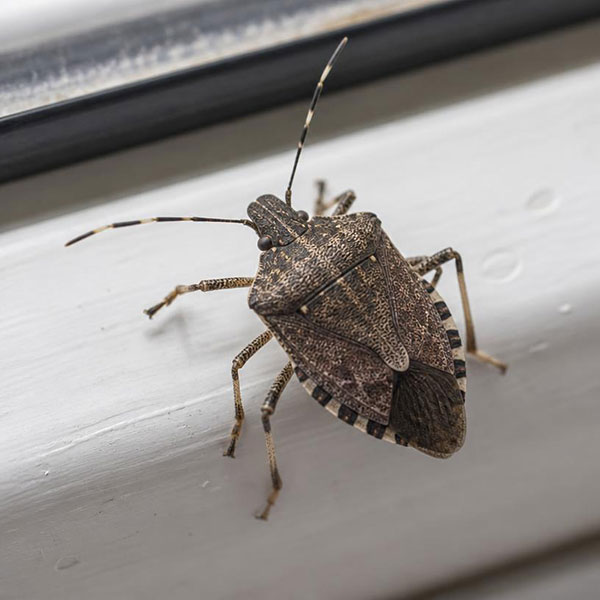
You walk past the living room window on a warm October afternoon and there it is: a flat, brown, shield-shaped bug the size of a fingernail, just sitting there. You go to flick it away — and suddenly the room smells like burnt cilantro.
Congratulations, you’ve met the brown marmorated stink bug.
Most people who call us about these don’t know the name yet. They search things like “smelly brown bug”, “shield shaped bug in house”, or “brown bug on window fall”. If that’s how you landed here, this guide will tell you exactly what you’re looking at, why it’s showing up now, and what actually works to get rid of stink bugs in an Ontario home.
How to Identify a Stink Bug
Stink bugs are easy to confirm once you know what to look for:
- Shape: a flat, wide shield or crest shape — like a tiny armoured badge.
- Size: roughly 12–17 mm, about the size of a nickel’s diameter.
- Colour: mottled greyish-brown, marbled rather than solid.
- Antennae: two clear white bands near the tips — the single most reliable ID feature.
- Abdomen edge: alternating light and dark bands sticking out past the wings.
- Behaviour: slow, clumsy, prone to bumping into lampshades and walls. They fly with a heavy buzz.
Look-alikes in Ontario include boxelder bugs (black with red-orange lines — narrower body) and western conifer seed bugs (longer, with flared back legs). All three are fall invaders and none of them are dangerous, but the stink bug is the one with the smell.
Yes — They Really Do Smell
The name isn’t marketing. Stink bugs have scent glands on the underside of the thorax. When crushed, squeezed, vacuumed roughly, or grabbed by a curious pet, they release a defensive compound that most people describe as cilantro, burnt rubber, or old gym socks.
The odour isn’t harmful, but it lingers on fabric, in vacuum bags, and on skin. That’s the #1 practical rule with stink bugs: don’t squash them.
Why They Show Up in September and October
Stink bugs don’t want to live in your house. They want to survive winter.
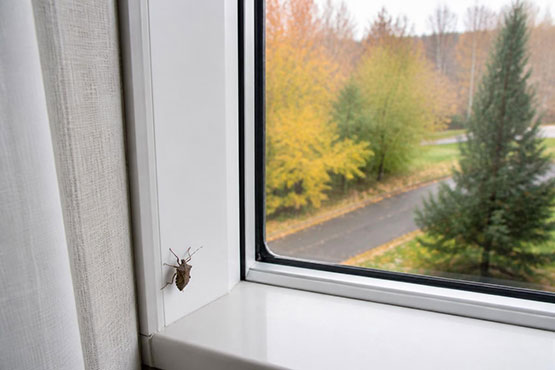
As nights cool below about 10 °C, they seek an overwintering site — historically a rock crevice or dead tree, now much more conveniently the sun-warmed south and west walls of your home. On a warm autumn afternoon you’ll see dozens gathering on siding, brick, and window trim. From there, they follow airflow into:
- gaps around window and door frames
- attic and soffit vents without proper screening
- utility penetrations (dryer vents, cable, A/C lines, gas lines)
- unscreened chimneys and roof vents
- worn weatherstripping and garage door seals
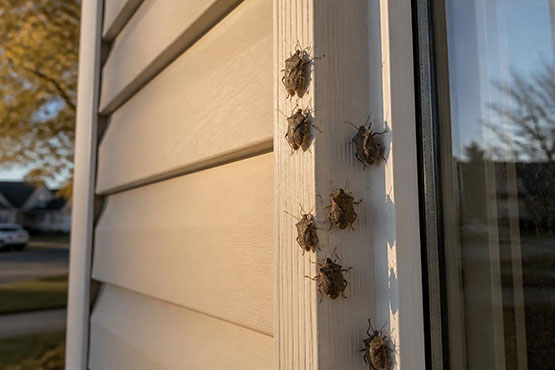
Once inside, they settle in wall voids, attics, and behind trim and go dormant. That’s why you’ll get a second wave in February and March — a mild spell or your furnace warming a wall cavity wakes them up, and they wander into the living space thinking it’s spring.
Are Stink Bugs Dangerous?
No. And this is genuinely good news:
- They don’t bite or sting.
- They don’t damage wood, drywall, insulation, or wiring the way carpenter ants or rodents do.
- They don’t breed indoors — the ones in your house came from outside; they’re not multiplying in your walls.
- They don’t feed on anything inside your home. They’re plant feeders (a serious problem for Ontario fruit and soybean growers, not for your kitchen).
The problem is nuisance and volume. A handful is annoying. A well-established overwintering population in a wall cavity can mean dozens to hundreds appearing over a season.
How to Get Rid of Stink Bugs Already Inside
Do this:
- Scoop, don’t squash. Slide a piece of paper under it, drop it into a jar of soapy water, and flush or discard it.
- Vacuum carefully. A shop vac with a nylon stocking rubber-banded over the hose end catches them without contaminating the machine — remove and discard the stocking outside afterward.
- Cut the attractants. Stink bugs are drawn to light. Close blinds at dusk and switch exterior fixtures to warm/yellow bulbs.
- Dehumidify basements and crawlspaces. Dry, sealed spaces are far less appealing as harbourage.
Skip this:
- Bug bombs and foggers. They don’t reach wall voids, and dead insects left inside cavities attract carpet beetles and dermestid larvae — trading one pest for a worse one.
- Crushing them on sills. The odour attracts more; the residue stains paint and trim.
- Hardware-store perimeter sprays applied in November. Timing is everything with stink bugs (more below).
The Only Long-Term Fix: Exclusion
You can’t out-vacuum a house that’s open to them. The permanent solution is sealing the building envelope before they move in.
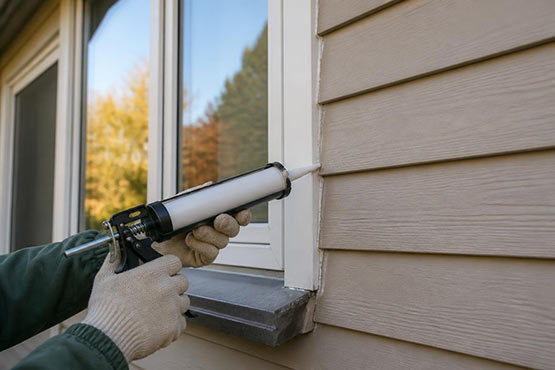
- Caulk gaps around window frames, door trim, and siding joints.
- Screen attic, soffit, gable, and bathroom exhaust vents with fine mesh.
- Seal around dryer vents, hose bibs, A/C line sets, and cable entries.
- Replace failed weatherstripping and garage door bottom seals.
- Repair torn window and door screens.
If this list sounds familiar, it should — it’s essentially the same work that keeps mice out of your house. One exclusion job addresses both, which is why we usually bundle them for clients heading into fall.
When to Call Swift-X
Call a professional if:
- You’re seeing more than a handful per week indoors
- They reappear each February and March (a sign of an established wall-void population)
- Your home has cedar or vinyl siding, a large south/west exposure, or an older attic with unscreened vents
- You’d rather not be on a ladder sealing soffits in November
The professional approach is timing plus sealing: a targeted exterior treatment applied to siding, trim, soffits, and window surrounds in late August through September — before they cluster — combined with an exclusion inspection to close entry points. Applied after they’re already in the walls, sprays do very little; applied at the right time, they’re extremely effective.
Swift-X Pest Control serves Toronto, the GTA, Barrie, and surrounding areas with discreet, unmarked service vehicles and next-day appointments in most cases.
Seeing brown shield-shaped bugs on your windows?
Call or text Swift-X for a fall exclusion inspection.
Related Reading:
Earwigs in the House? Why They Show Up and How to Get Rid of Them
House Centipedes in Your Home? Why They’re There and How to Get Rid of Them
Silverfish in Your Bathroom or Basement? Here’s Why They’re There and How to Get Rid of Them