

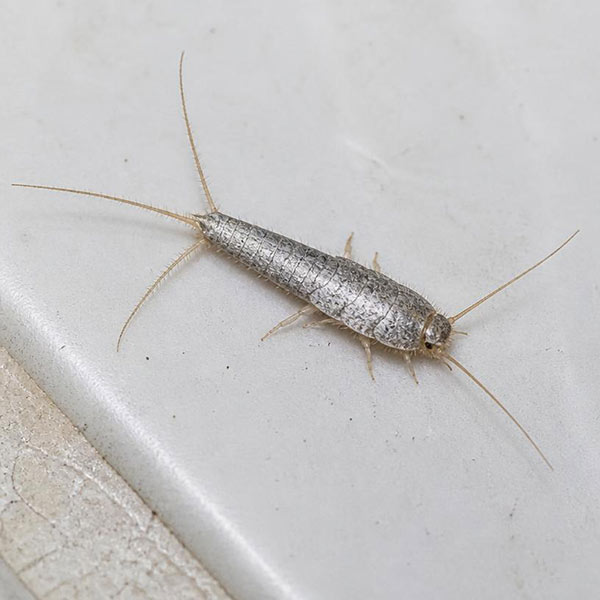
You flip on the bathroom light at 2 a.m. and something silver darts across the tile and vanishes behind the baseboard. It moved fast, it wriggled like a tiny fish, and it left you standing there wondering what exactly just ran past your feet.
That was almost certainly a silverfish — and in a humid Toronto August, it is one of the most common calls we get. Here’s what they are, why they picked your home, and how to get rid of silverfish for good.
What silverfish actually are
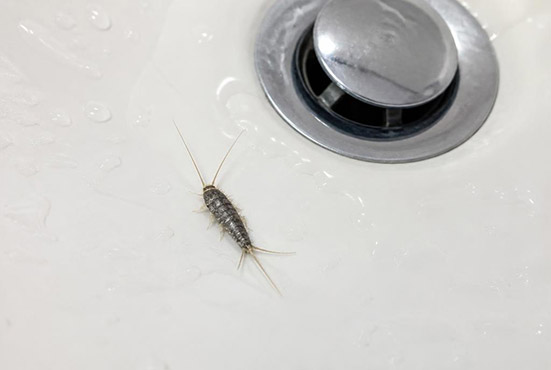
Silverfish (Lepisma saccharina) are wingless, teardrop-shaped insects about 12–19 mm long. They’re covered in fine silvery-grey scales, have two long antennae at the front, and three bristle-like tails at the back. They can’t fly or climb smooth vertical surfaces, which is why one so often ends up stranded in a sink or tub.
They are among the oldest insect groups on earth — they were around long before dinosaurs — and they are stubborn survivors. A silverfish can live two to eight years and go weeks without food.
Good news first: silverfish don’t bite, don’t sting, and don’t carry disease. They are a nuisance and a property-damage pest, not a health threat.
Why silverfish are in your house
Silverfish need two things, and most GTA homes offer both.
1. Humidity
Silverfish thrive at 75–95% relative humidity. That’s why you find a bathroom centipede’s neighbour in the same rooms — bathrooms, laundry rooms, under kitchen sinks, and unfinished basements. Toronto summers push indoor humidity high, and older GTA homes with block foundations, no basement dehumidifier, or a bathroom fan that vents nowhere useful become ideal habitat.
2. Starch and paper
Silverfish eat carbohydrates — specifically starches, sugars and cellulose. Their menu includes:
- Cardboard boxes and the glue in the seams
- Books, paper, photographs, wallpaper paste
- Dry pet food, flour, cereal, oats
- Natural fibres like cotton, linen and silk
- Dead insects and shed skin
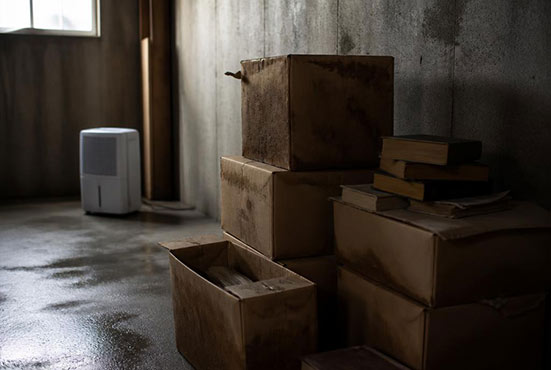
Which is why silverfish in basements show up first in the storage corner: damp cardboard on a cool concrete floor is both shelter and dinner.
Where you’ll find them
| Location | Why they’re there |
|---|---|
| Bathroom floor, tub, sink | Highest humidity in the house; they fall in and can’t climb out |
| Basement storage | Damp cardboard, paper, cool concrete |
| Under kitchen sinks | Pipe condensation and slow leaks |
| Laundry room | Dryer humidity, lint, natural fibres |
| Attics | Insulation paper backing, cardboard, roof leaks |
| Behind baseboards and wall voids | Dark, undisturbed, close to moisture |
If you’re seeing a centipede inside the house in the same rooms, that’s not a coincidence — house centipedes hunt silverfish. A centipede problem is often a silverfish problem you haven’t found yet. (We wrote a separate guide on house centipedes if that’s also on your list.)
How to tell how bad it is
One silverfish in a tub in August is usually a wanderer. Signs of an established population:
- Multiple sightings in a week, especially in different rooms
- Tiny irregular holes or notches in book pages, wallpaper, or stored clothing
- Yellowish stains on paper or fabric
- Small black pepper-like droppings in drawers, boxes or on shelves
- Shed skins — silverfish moult throughout their lives
- Damaged wallpaper edges where they’ve fed on the paste
How to get rid of silverfish: what actually works
Step 1: Take away the humidity
This is the single most effective thing you can do, and nothing else works well without it.
- Run a dehumidifier in the basement and hold it below 50% RH
- Run bathroom exhaust fans during showers and for 20 minutes after
- Fix dripping taps, sweating pipes and slow toilet leaks
- Insulate cold water pipes to stop condensation
- Improve airflow in closets and storage rooms
Step 2: Take away the food and shelter
- Swap cardboard for sealed plastic bins in the basement and garage. This one change solves more silverfish problems than any spray.
- Store flour, cereal, oats and pet food in airtight containers
- Clear out old newspapers, magazines and paper stacks
- Vacuum baseboard edges, closet corners and under furniture
- Keep stored clothing in sealed containers or garment bags
Step 3: Seal the routes
Caulk gaps around baseboards, pipe penetrations under sinks, and cracks in basement walls and floors. Silverfish travel through wall voids between units and rooms, so closing those routes matters — especially in condos and semis.
Where DIY runs out
Sprays from a hardware store kill the silverfish you see. They don’t reach the ones living in the wall void behind your vanity, in the subfloor, or in the insulation — and that’s where the population actually lives. Diatomaceous earth can help in dry voids but does nothing in the damp areas silverfish prefer. Sticky traps monitor a problem; they don’t end one.
If you’ve dehumidified, decluttered and sealed and you’re still seeing them after a few weeks, the population is established somewhere you can’t reach.
Professional silverfish extermination in Toronto
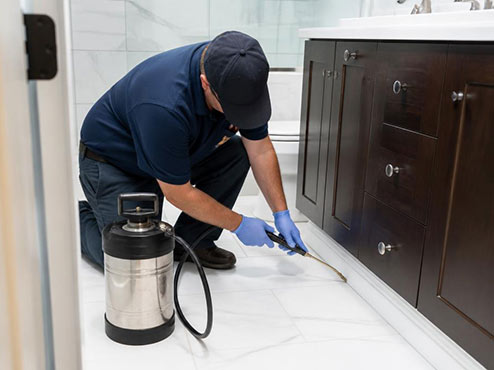
Here’s what our silverfish pest control service looks like:
- Moisture and harbourage inspection. We find the source — the leaking supply line, the unvented bathroom fan, the crawlspace with no vapour barrier. Treating without this just buys you a few weeks.
- Crack-and-crevice treatment. Targeted residual product placed into baseboard gaps, under vanities, along sill plates and into wall voids where silverfish actually live. Precise placement, not blanket spraying of living space.
- Void dusting. A long-lasting insecticidal dust into wall voids, plumbing chases and under-cabinet gaps, where it stays effective for months.
- Attic and/or basement coverage where insulation or stored paper is involved.
We service Toronto, North York, Scarborough, Etobicoke, Mississauga, Brampton, Vaughan, Markham, Richmond Hill, Barrie and the surrounding areas. Treatments are pet- and child-safe when used as directed, and technicians arrive in discreet unmarked vehicles.
Frequently asked questions
Are silverfish dangerous? No. They don’t bite, sting or transmit disease. They damage paper, books, wallpaper, packaged food and natural fabrics.
Does one silverfish mean an infestation? Not necessarily. A single sighting in a tub is often a wanderer. Repeated sightings, droppings, shed skins or paper damage point to an established population.
Why are silverfish in my bathroom specifically? It’s the most humid room in the house. They also fall into tubs and sinks and can’t climb the smooth sides back out, so that’s where you notice them.
Do silverfish go away on their own? Rarely. They live for years and reproduce steadily. If the moisture and food are still there, so are they.
Can silverfish get into a condo from a neighbouring unit? Yes. They travel through shared wall voids, plumbing chases and baseboard gaps. Sealing your unit’s entry points is an important part of the fix.
How long does treatment take to work? You’ll usually see a sharp drop within one to two weeks.
Do silverfish eat clothes? They feed on starch and natural fibres, so stored cotton, linen and silk can be damaged — especially anything starched.
Seeing silverfish? Let’s take care of it.
Swift-X Pest Control offers next-day silverfish treatment across Toronto, the GTA and Barrie, with a written guarantee and honest flat-rate pricing.
Call or text (647) 478-2128 for a free quote.
Related Articles:
How to Get Rid of House Centipedes in Your Home
I Found a Spider in My Bed — Should I Worry?