

If you’ve been swatting wasps away from your patio table all month, you’re not imagining it. Late August and September are the worst weeks of the year for yellowjackets in Toronto, Barrie and across the GTA — and whether you spell it “yellowjackets” or “yellow jackets,” the calls we get all sound the same: they came out of nowhere, and now we can’t use the backyard.
Be sure to check our was yellowjacket/wasp/bee general service page if you think you have an issue that requires attention.
Here’s why they’re suddenly everywhere, where the nest is probably hiding, and what actually solves it.
Why Yellowjackets Get Aggressive in Late Summer
A yellowjacket colony starts in spring with a single queen. By August, that nest can hold 2,000 to 5,000 workers. Two things happen at once:
- The colony peaks in size — the most wasps it will ever have, all needing food.
- The food supply shifts. Earlier in summer, workers hunt insects to feed larvae. By late summer the queen stops laying, the larvae are gone, and the workers switch to sugar. That’s why they’re suddenly in your pop can, your garbage bin and your barbecue.
So it’s not that yellow jackets got mean. It’s that thousands of them are now unemployed, hungry for sugar, and defending a nest at maximum population. A nest you walked past all July becomes a serious hazard in September.
Yellowjackets vs. Bees vs. Hornets — Quick ID
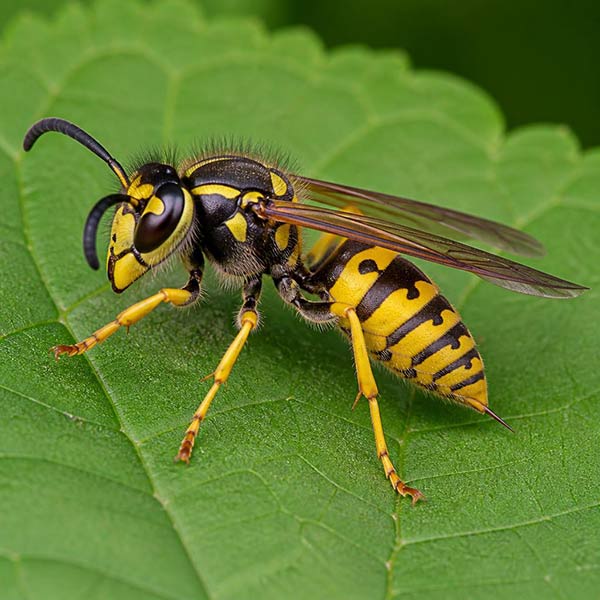
- Yellowjackets — smooth, shiny, bright yellow-and-black bands, about 1/2 inch. Fast, darting flight. Aggressive near the nest. These are the ones at your picnic.
- Honeybees — fuzzy, golden-brown, rounder. Interested in flowers, not your food. We don’t exterminate honeybees.
- Bald-faced hornets — larger, black with a white face, build the big grey football-shaped nests in trees and on eaves.
- Paper wasps — slender, long dangling legs, build small open umbrella-shaped combs under railings and door frames.
If it’s chasing your hamburger, it’s a yellowjacket.
Where Yellow Jackets Nest Around Toronto Homes
This matters more than anything else, because the nest location decides how the treatment is done.
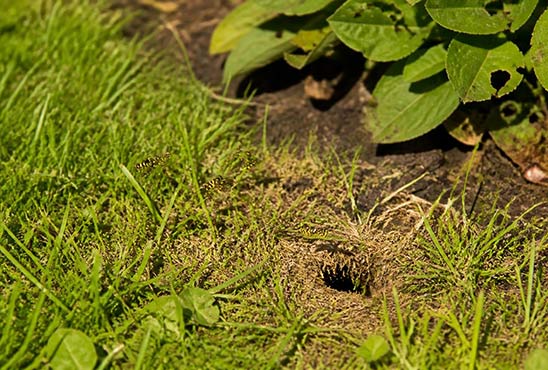
In the ground (about half our calls). Abandoned rodent burrows, gaps beside patio stones, under retaining walls, in mulch beds. The only visible sign is a small hole with steady traffic in and out. Mowing over one is how most people find out.
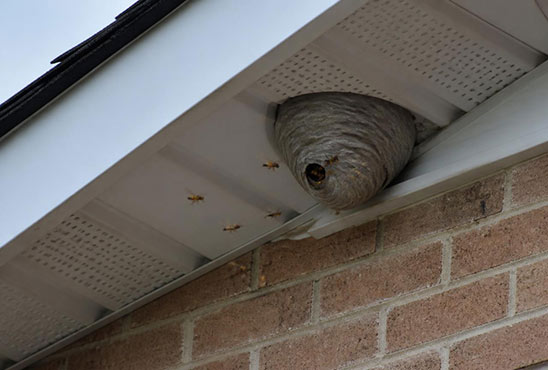
In the structure. Soffits and eaves, gaps in siding, behind fascia boards, in the brick weep holes, inside a wall void, in the attic. You’ll see a steady stream of wasps disappearing into a single gap under the roofline.
In hollow spaces. Composters, unused BBQs, kids’ playsets, hollow fence posts, hose reels, birdhouses, that stack of patio cushions.
Why You Shouldn’t Spray a Yellowjacket Nest Yourself
Store-bought wasp spray works reasonably well on a small, visible paper wasp comb. It is a poor choice for a mature yellowjacket nest, for three reasons:
- Ground nests fight back. Foam sprayed at the entrance hits maybe the front chamber. The rest of the colony exits — often through a second entrance — and defends. Yellowjackets can sting repeatedly and will pursue you 15+ metres.
- Wall and soffit nests get worse when done wrong. Sealing the entry hole is the single most common DIY mistake. The colony doesn’t die; it chews inward looking for a new exit, and that exit is often a ceiling light fixture or a bathroom vent inside your home.
- Ladders and stings don’t mix. Most serious wasp injuries in Ontario aren’t the sting — they’re the fall.
If anyone in the household has a known sting allergy, skip the DIY step entirely.
How Swift-X Handles Yellowjacket Nest Removal
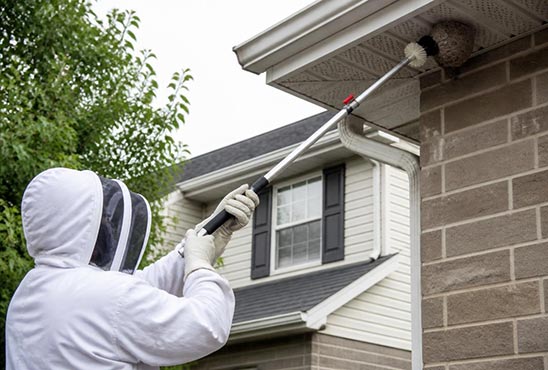
- Locate the actual nest. Wasps at the patio table are foraging workers — they may be nesting three properties over. We track flight lines to the real entry point, and we check for secondary entrances before treating.
- Treat at the source, in protective gear. Ground and void nests get a dust applied directly into the entrance. Returning foragers track it into the colony over the following hours, which is what reaches the queen and the brood — not just the wasps you can see.
- Leave the entrance open. We deliberately do not seal a structural nest on treatment day. The colony has to keep using that hole for the product to work, and forcing them inward is how wasps end up in living space.
- Remove or seal after die-off. Once activity stops (usually 24–72 hours), accessible nests can be removed and the entry point sealed so a new queen doesn’t reuse it next spring.
- Perimeter treatment. For properties with repeat problems, we treat soffits, eaves, railings and door frames to discourage new nests from establishing.
We serve Toronto, the GTA and the Barrie area, with next-day service available in most cases and same-week scheduling in peak wasp season. Because wasp work is time-sensitive and often up a ladder, call or text us with the location of the nest and we’ll tell you honestly what’s involved before we come out.
Preventing Yellow Jackets Next Season
- Seal in early spring, not late summer. Caulk gaps in soffits, siding and fascia in April before queens are scouting. A dime-sized gap is plenty.
- Screen vents. Attic, gable, dryer and bathroom vents should all have intact mesh.
- Use lidded garbage and rinse recyclables. Sugar residue on cans is a beacon in August.
- Move compost and bins away from doors and patios where you sit.
- Check hollow items before the season. Unused BBQs, playsets, and hose reels are prime real estate.
- Knock down brand-new nests in May or June. A golf-ball-sized nest with one queen is a very different job than a 3,000-wasp colony in September.
Frequently Asked Questions
Do yellowjackets die off in winter? Yes. In Ontario, hard frost kills the workers and the old queen. Only newly mated queens survive, overwintering under bark or in leaf litter. However, an untreated nest in a wall still needs attention — the dead nest material can attract carpet beetles and other secondary pests, and the same sheltered spot often gets reused.
Will they reuse last year’s nest? Yellowjackets don’t reuse the actual nest, but they absolutely reuse the location — the same soffit gap or ground burrow. Sealing after removal is what breaks the cycle.
Is it too late in the season to treat? No. Late-season nests are the biggest and most aggressive, so they’re often the most worth treating. Waiting for frost means several more weeks of an unusable yard.
How many times can a yellowjacket sting? Unlike honeybees, a yellowjacket’s stinger is smooth — it can sting repeatedly, and disturbed colonies attack in numbers. That’s the main reason ground nests should be handled professionally.
How fast do they die after treatment? Most activity drops sharply within a few hours and stops within 24–72 hours as returning foragers spread the product through the colony. Seeing a few stragglers on day two is normal.
Yellowjackets taking over your yard? Call or text Swift-X Pest Control for yellowjacket and wasp nest removal in Toronto, the GTA and Barrie. Discreet unmarked vehicles, licensed technicians, and next-day service in most areas.
Related reading: Wasps, Hornets and Carpenter Bees in Toronto: How to Tell Them Apart