

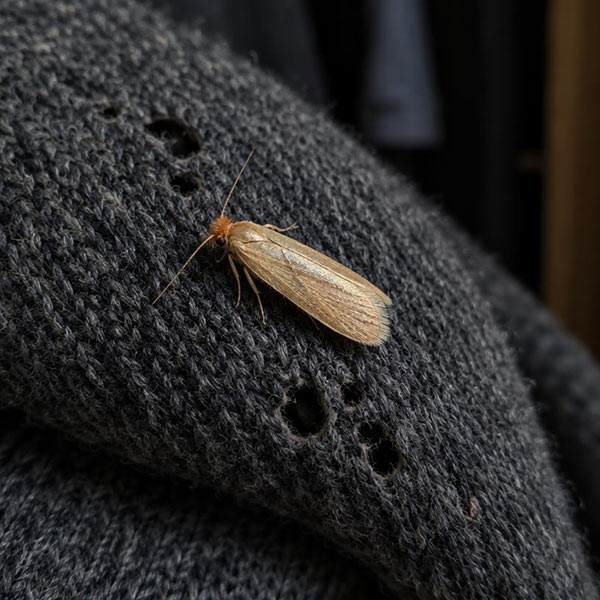
You pull your favourite wool sweater out of the closet and find a cluster of small, irregular holes. Maybe you’ve also noticed tiny, pale moths fluttering near the closet floor. Clothes moths are one of the most common fabric pests in Toronto homes, especially in older houses, condos with deep closets, and anywhere natural fibres sit undisturbed for months.
The catch: carpet beetles cause almost identical damage. Treating for the wrong pest wastes time and money, so this guide starts with identification, then walks you through exactly what to do.
Do Moths Actually Eat Clothes?
Yes, but not the adult moths you see flying. The larvae do all the damage. Adult clothes moths don’t feed at all. Their only job is to mate and lay eggs. A single female can lay 40 to 50 eggs directly on fabric, and the larvae that hatch feed on keratin, the protein found in:
- Wool, cashmere, mohair and alpaca
- Silk and feathers (down pillows, duvets)
- Fur and leather
- Felt, wool rugs and upholstery
- Pet hair and human hair collecting in corners
Synthetics like polyester are usually safe unless they’re blended with wool or stained with sweat, food or body oils, which larvae will happily eat through.
How to Identify Clothes Moths
There are two species you’ll find in GTA homes.
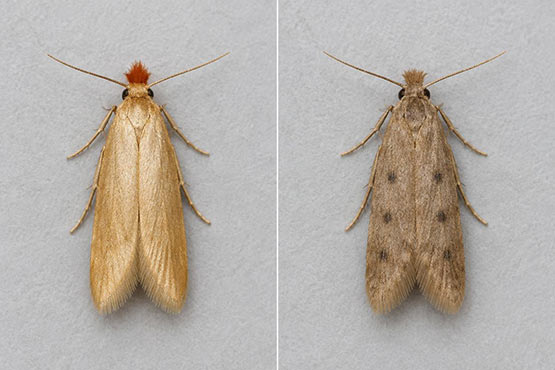
Webbing clothes moth (Tineola bisselliella)
The most common. Adults are about 6 to 8 mm long, a uniform golden or buff colour with a shiny look and a small tuft of reddish hair on the head. No spots or patterns on the wings.
Casemaking clothes moth (Tinea pellionella)
Slightly duller and browner, often with faint dark spots on the wings. Less common in Toronto but worth knowing.
Key behaviour clues
- They avoid light. Clothes moths hide in dark closets, under furniture and in folds of fabric. A moth flying around a lamp at night is almost never a clothes moth.
- They flutter low and weakly rather than flying across the room.
- Pantry moths are different. If the moths you’re seeing have two-toned wings (pale front, coppery back half) and you find them near the kitchen, they’re likely Indian meal moths, a food pest, not a fabric pest.
Signs of the larvae
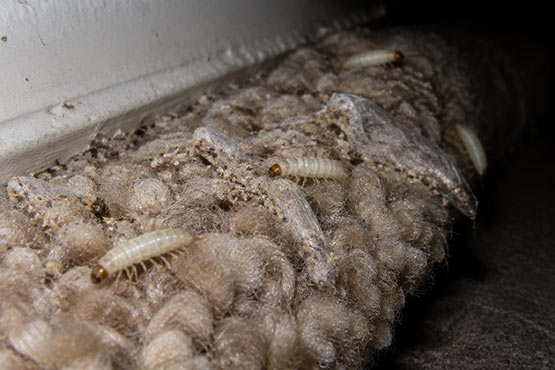
- Silken tubes or webbing on fabric (webbing clothes moth)
- Small portable cases made of silk and fibre that the larva drags around, often the same colour as the fabric it’s eating (casemaking clothes moth)
- Frass: tiny, sand-like droppings, often the same colour as the fabric
- Creamy-white larvae with a darker head, up to about 12 mm long
- Damage concentrated in hidden areas: under collars, cuffs, armpits, seams, and the underside of rugs
Clothes Moths vs Carpet Beetles: How to Tell Them Apart
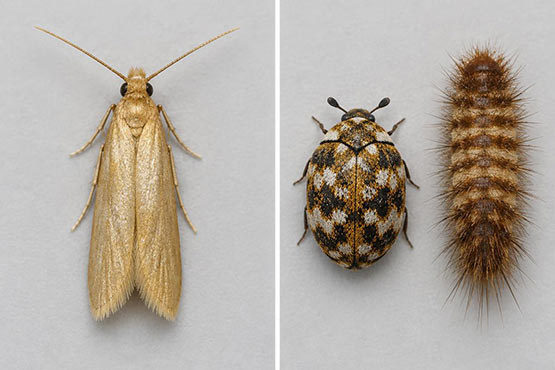
This is the most important step. Both pests eat the same materials and both leave holes, but they look and behave very differently.
| Clothes moths | Carpet beetles | |
|---|---|---|
| Adult | Small golden or buff moth, 6 to 8 mm, flutters weakly | Small round beetle, 2 to 4 mm, mottled black, white and yellow (or solid black) |
| Larva | Smooth, creamy-white “worm” with a dark head | Fuzzy, bristly, brown or striped “woolly bear” |
| Silk or webbing | Yes, tubes, webbing or cases | No webbing |
| Shed skins | Rarely noticed | Lots of shed, hairy brown skins left behind |
| Damage pattern | Scattered holes, often with silk and frass on the fabric | Fewer, larger, more defined holes; damage often near baseboards or rug edges |
| Where adults go | Stay in dark closets, avoid light | Attracted to light, found on windowsills |
| Outdoor link | Rarely outdoors | Adults feed on flower pollen in spring and fly in through windows |
Quick rule: silk or webbing means moths. Fuzzy larvae and piles of hairy shed skins mean carpet beetles. Small beetles on your windowsills in spring point strongly to carpet beetles.
If you suspect carpet beetles instead, read our guide to carpet beetles in Toronto.
How to Get Rid of Clothes Moths: Step by Step
1. Find every infested item
Empty the affected closet and drawers completely. Check wool, silk, cashmere, fur and feathers first, especially items stored for a long time. Look under collars, along seams and inside folds. Don’t forget wool rugs (flip them over), upholstered furniture, felt piano hammers, and stored boxes in the basement.
2. Kill the larvae and eggs in your clothing
Choose the method that suits the fabric:
- Wash hot: wash and dry at the highest temperature the label allows. Heat above 50°C kills all life stages.
- Dry clean: for delicates, suits and coats that can’t be washed.
- Freeze: seal items in a plastic bag, push out the air and freeze at -18°C or colder for at least 72 hours. Let the bag come back to room temperature before opening to avoid condensation. Note: a few days outside in a Toronto winter is not reliable, because temperatures swing too much.
- Brush and sun: for items you can’t wash, brush them outdoors firmly (larvae and eggs drop off) and leave them in direct sunlight for a few hours. Larvae hate light.
3. Vacuum thoroughly
Vacuum closet floors, shelves, baseboards, under furniture, along carpet edges and inside heating vents. Larvae love the lint, hair and dust that collects in these spots. Empty the vacuum outside immediately, or seal and toss the bag.
4. Clean the closet
Wipe shelves and rods with soapy water. Pay attention to corners and cracks where eggs can hide.
5. Use pheromone traps to monitor
Pheromone traps attract male webbing clothes moths. They won’t solve an infestation on their own, but they tell you whether the problem is still active. Place one or two per closet and check them every couple of weeks.
6. Store clean, protected
- Only store clothes that have been washed or dry-cleaned. Sweat and food stains attract larvae.
- Use airtight bins or zippered garment bags, not cardboard boxes.
- Disturb stored items regularly: shake out and air sweaters every month or two.
Do cedar and lavender work?
They help a little, but only as a mild deterrent. Cedar oil loses its effect over time (sand cedar blocks every season to refresh it), and neither will kill existing larvae. Mothballs do work in sealed containers, but the fumes are toxic and unpleasant, so we don’t recommend them in living spaces, especially around kids and pets.
When to Call a Professional
DIY works well for a single closet caught early. Call in a professional if:
- You keep finding new damage after cleaning and treating
- Moths are showing up in multiple rooms
- Wool rugs, upholstered furniture or wall-to-wall carpet are affected
- You have valuable items (furs, heirloom rugs, vintage clothing) at risk
- You’re not sure whether it’s moths or carpet beetles
Swift-X Pest Control inspects to confirm exactly what you’re dealing with, then treats closets, carpets and hidden harbourage areas with targeted, pet- and child-safe options. Service is discreet, and we serve Toronto and the GTA.
Seeing holes in your sweaters? Call or Text Swift-X at (647) 478-2128 for a fast, honest assessment.
FAQ
Do clothes moths bite? No. Neither adults nor larvae bite people or pets. They only damage fabrics.
Why are clothes moths worse in the fall and winter? They’re active year-round indoors, but people notice them when sweaters and coats come out of storage in the fall. Warm, heated homes also let them breed through the winter.
How long does it take to get rid of clothes moths? A small, caught-early problem can be cleared in a couple of weeks. Larger infestations can take 1 to 3 months, because eggs hatch in cycles and you need to break each one.
Can clothes moths live in carpets? Yes. Wool and wool-blend carpets and rugs are a common hiding place, especially under furniture where they’re rarely vacuumed.
Are the moths in my kitchen clothes moths? Probably not. Moths near food are usually pantry moths (Indian meal moths), which have two-toned wings and feed on grains, flour and dried food.
How do I know if it’s clothes moths or carpet beetles? Look for silk webbing or small cases (moths) versus fuzzy brown larvae and shed hairy skins (carpet beetles). Carpet beetle adults also gather on windowsills.
Related Reading:
Carpet Beetles in Homes, Condos & Dwellings: Identification, Behaviour & Prep Guide