

Ant Control in Toronto – Next-Day Exterminator Service Available for Every Species

A trail of ants in the kitchen, sawdust under a window frame, or tiny mounds on the driveway — every ant problem in Toronto starts small and gets worse fast. The right treatment depends entirely on which ant you’ve got. Carpenter ants damage wood. Pharaoh ants split into satellite colonies the moment you spray them. Pavement ants explode in late spring. Swift-X identifies the species, treats the colony at its source, and backs every job with a written guarantee.
Call (647) 478-2128 for same-day service · Free quote · Licensed & insured
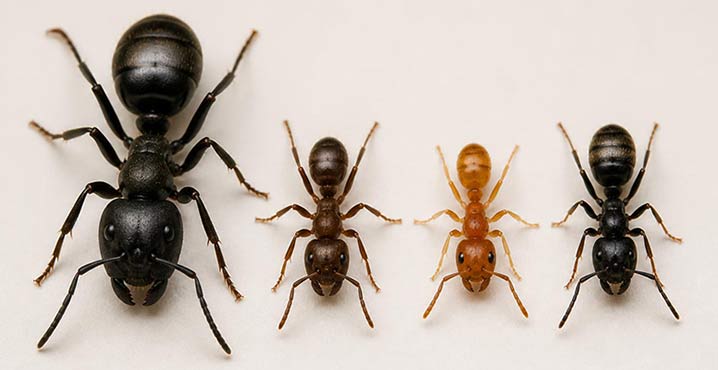
The 4 Most Common Ants in Toronto Homes
Carpenter Ants — Large (6–13 mm), usually black, sometimes reddish-black. They don’t eat wood, they tunnel through it — usually wood that’s been softened by a moisture leak. Telltale sign: small piles of sawdust-like “frass” with insect parts in it. Big winged “swarmers” inside the house in spring = mature colony.
Deep-dive: Carpenter Ants in Toronto — Identifying, Treating, and Preventing Wood Damage
Pavement Ants — Small (2.5–4 mm), dark brown to black. The mound-builders along driveways, patios, and foundation cracks. They invade kitchens in late spring for grease and sweets.
Pharaoh Ants — Tiny (1.5–2 mm), pale yellow to light brown. The hardest household ant to control — they “bud” when sprayed, scattering into multiple new colonies. Never DIY-spray pharaoh ants. They require slow-acting baits placed by a pro.
Odorous House Ants — Small (2.5–3 mm), dark brown to black. Crush one and it smells like rotten coconut. Common in kitchens, especially around dishwashers and under sinks.
Want the full breakdown? Read our blog: The 3 Most Common Ants in the GTA — How to Spot Them
Here is a more extended list of ants most commonly found in a household or around the home’s exterior anywhere from Toronto, and to the North of Barrie:
Carpenter ant

Pavement ant

Odorous house ant

Ghost ant

Crazy ant

Fire ant

Rover ant

Argentine ant

Signs You Have an Ant Problem
- Trails of ants along baseboards, counters, or window frames
- Small mounds of fine soil on driveways, walkways, or near the foundation
- Sawdust-like piles under wood trim, window sills, or in basements (carpenter ants)
- Winged “flying ants” inside the home — usually means a mature indoor colony
- Ants in the bathroom or around water sources (often pharaoh or odorous)
- Recurring “trails” that come back days after you wipe them down
Why DIY Sprays Often Make It Worse
Store-bought sprays kill the ants you see — typically less than 5% of the colony. The queen and the rest stay safely hidden, and with pharaoh ants and some odorous ant colonies, spraying actively triggers budding: workers carry the queen and brood to a new location, and you end up with 2–3 infestations instead of one. Professional treatment uses non-repellent products and slow-acting baits that workers carry back to the queen.
What You Can Do Before We Arrive
- Stop spraying. Especially for pharaoh, odorous, and carpenter ants.
- Don’t wipe out the trail right before treatment. We want to see where they’re coming from and going to.
- Clear counters and accessible cabinets so we can treat cracks, hinges, and corners.
- Find the moisture. Carpenter ants follow water — note any past leaks, sweating pipes, or soft trim around windows and tubs.
- Identify entry points if you can — gaps around utility lines, weep holes, foundation cracks, window frames.
- Pets: plan to be out with them for 4 hours after interior treatment.
- Outdoor jobs: pull patio furniture and toys back from the foundation.
Our Treatment Process
- Species ID & inspection — interior trails, exterior foraging routes, satellite nests, moisture sources.
- Targeted treatment — non-repellent residual along entry points and harbourage zones, gel baits on active interior trails, granular bait around the exterior perimeter for foraging colonies.
- Carpenter ant protocol — locate the parent colony (often in a tree or stump within 100 m of the home), treat satellite nests inside, dust wall voids where active.
- Pharaoh ant protocol — bait-only, no sprays; multiple bait stations rotated over 4–6 weeks.
- Follow-up — most cases include one follow-up at 2–4 weeks.
- Written guarantee — if activity returns within the guarantee window, we return at no charge.
Preventing Ants from Coming Back
- Seal cracks around foundation, weep holes, utility penetrations, and window frames
- Trim tree branches and shrubs away from the house (carpenter ant highways)
- Fix moisture issues — leaky taps, sweating pipes, downspouts dumping at the foundation
- Store sugar, honey, pet food, and open snacks in sealed containers
- Rinse recycling before it goes in the bin
- Move firewood and mulch at least 1 m from the foundation
- Annual exterior perimeter treatment in spring for high-pressure properties
Why Toronto Homeowners Choose Swift-X
- MOECC-licensed technicians, insured
- Same-day service across Toronto, North York, Scarborough, Etobicoke, Mississauga, Vaughan, Markham, Brampton & the rest of the GTA
- Species-specific protocols — no one-spray-fits-all
- Written guarantee on every treatment
- Pet- and child-safe product options
- Stellar Google reviews