

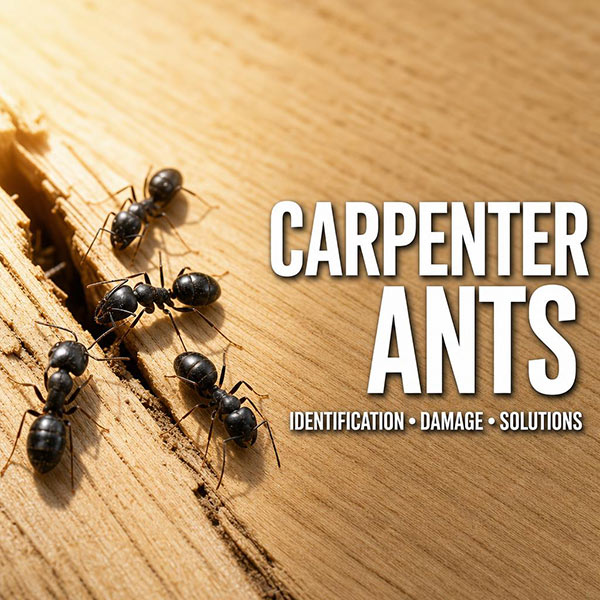
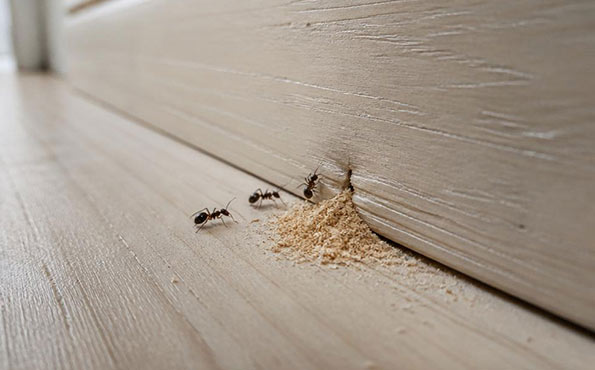
If you’ve noticed large black ants wandering across your kitchen counter, marching along a baseboard, or — worst of all — spilling out of a wall, there’s a good chance you’re looking at carpenter ants. They’re one of the most common (and most destructive) household pests in Toronto and the GTA, and unlike the tiny sugar ants most people brush off, carpenter ants can quietly cause serious structural damage to your home.
Here’s what every homeowner and renter should know.
What Are Carpenter Ants?
Carpenter ants (Camponotus species) are large ants that nest inside wood. Unlike termites, they don’t eat the wood — they tunnel through it to build their colonies, hollowing out galleries that look almost sandpapered-smooth on the inside.
In Ontario, the most common species is the black carpenter ant, and it’s a big one. Workers range from about 6 mm to 13 mm long, and the queen can be close to 2 cm. If you see an ant in your house that looks “too big to be a normal ant,” it probably is — and it’s probably a carpenter ant.
How to Identify a Carpenter Ant
It’s easy to mistake carpenter ants for other ants or even termites. See our other article describing the other most common ants appearing in homes across Ontario. Here’s how to tell them apart at a glance:
- Size: Noticeably larger than typical household ants.
- Colour: Usually solid black, sometimes dark reddish-brown or a black-and-red combination.
- Body shape: A single, pronounced hump (node) between the thorax and abdomen, and a smooth, evenly rounded thorax when viewed from the side.
- Antennae: Bent (“elbowed”), not straight.
- Wings: Two pairs of wings, with the front pair noticeably longer than the back pair.
Carpenter Ants vs. Termites
This is the mix-up that costs homeowners the most money. A quick cheat sheet:
| Feature | Carpenter Ant | Termite |
|---|---|---|
| Waist | Pinched, narrow | Straight, no waist |
| Antennae | Bent | Straight |
| Wings | Front pair longer than back | Both pairs equal length |
| Wood damage | Smooth, clean galleries | Mud-packed, ragged tunnels |
If you’re not 100% sure what you’re looking at, snap a clear photo and have a licensed pest control technician identify it — getting this wrong delays treatment.
Signs and Symptoms of a Carpenter Ant Infestation
Carpenter ants are sneaky. By the time you actually see ants in the open, the colony has often been established for months or even years. Watch for these warning signs:
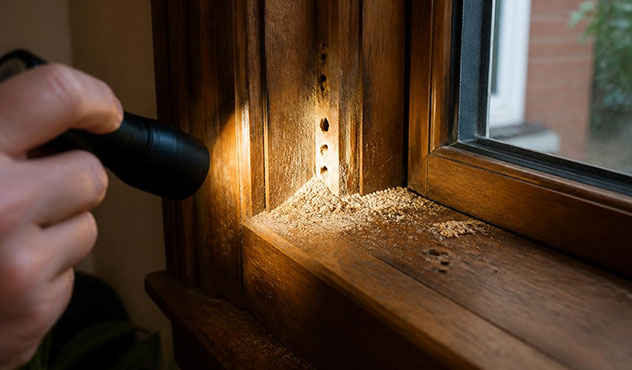
1. Large Black Ants Indoors — Especially at Night
Carpenter ants are most active after dusk. If you flick on the kitchen light at 11 p.m. and see big black ants on the counter, the floor, or near the sink, that’s a red flag.
2. Frass (Sawdust-Like Shavings)
This is the classic giveaway. As carpenter ants excavate their galleries, they push the debris out of small “kick-out” holes. The result is small piles of what looks like fine sawdust — often mixed with bits of dead ants and insulation — under windowsills, in basements, near baseboards, or beneath wooden beams.
3. Faint Rustling Inside Walls
A large, active colony can actually be heard. Press your ear against a suspect wall on a quiet evening — a soft crackling or rustling sound (like crinkling cellophane) often means workers are moving inside the wood.
4. Hollow-Sounding Wood
Tap along window frames, door frames, baseboards, and structural beams. If a section sounds noticeably hollow compared to the surrounding wood, that’s worth investigating.
5. Winged Swarmers Inside the House
In spring and early summer, mature colonies produce winged reproductives (“swarmers”) that fly off to start new colonies. Finding winged ants indoors — especially around windows — usually means there’s a mature, established colony inside your home, not outside.
6. Trails Leading to Moisture
Carpenter ants love damp, softened wood. Look for trails along leaky pipes, around bathtubs, beneath dishwashers, near roof leaks, around skylights, or along exterior trim where water has gotten in.
What Damage Can Carpenter Ants Actually Do?
Here’s where things get serious. Carpenter ants don’t cause damage as quickly as termites, but a mature colony of 10,000 to 50,000 workers — which is realistic for a long-standing infestation — can do real structural harm over time, including:
- Weakening wall studs, joists, and beams
- Hollowing out window and door frames until they no longer hold fasteners
- Damaging roof trusses and fascia boards
- Destroying decks, porches, and sheds from the inside out
- Compromising sub-floors around bathrooms, kitchens, and laundry rooms
Because Toronto homes deal with freeze-thaw cycles, ice dams, and humid summers, moisture damage and carpenter ants often go hand in hand. Wherever there’s a slow leak, soft wood, or poor ventilation, you have a five-star carpenter ant resort.
It’s also important to know that carpenter ants in your home almost always mean there’s a “parent” colony outside — typically in a dead tree, stump, woodpile, or stretch of damp landscaping — with one or more satellite colonies inside your house. Treating only what you see indoors usually doesn’t solve the problem.
At What Stage Should You Call a Professional?
Short answer: as soon as you suspect carpenter ants — not after.
Here are the situations where you should pick up the phone right away rather than experimenting:
- You’ve spotted more than a few large black ants indoors, especially at night.
- You’ve found frass (sawdust-like piles) anywhere in the home.
- You’re seeing winged swarmers inside.
- You’ve tapped wood that sounds hollow, or noticed soft spots around windows, door frames, or the bathroom.
- You’ve had a roof leak, plumbing leak, or ice-dam damage in the past year or two.
- You’ve already tried a store-bought spray or bait and the ants are still there (or seem to have multiplied).
Here’s why DIY usually backfires with carpenter ants: most over-the-counter sprays kill the workers you see, but don’t touch the queen or the hidden satellite colonies. Worse, repellent sprays can cause the colony to “bud” — splitting into multiple smaller colonies — which makes the problem harder and more expensive to fix later.
A licensed technician will:
- Inspect the interior and exterior to locate active trails, frass, and likely nest sites.
- Identify the species and colony stage (a parent colony outside almost always exists).
- Apply targeted, professional-grade products in the right spots — wall voids, exterior perimeters, entry points — using methods that don’t just scatter the colony.
- Address conducive conditions: moisture, wood-to-soil contact, gaps in trim, firewood piled against the house.
- Follow up to confirm the colony is eliminated, not just suppressed.
Toronto-Specific Things Worth Knowing
A few local realities that matter:
- Peak season is spring through early fall. You may see the most activity from April to September, but a colony already inside a heated home can stay active year-round.
- Older homes in neighbourhoods like the Annex, Leslieville, Riverdale, High Park, Etobicoke, and Scarborough often have mature trees, original wood trim, and decades-old framing — all of which carpenter ants love.
- Condos and townhomes aren’t immune. Shared walls, planter boxes on balconies, and damp underground parking levels can all support colonies.
- Renters: if you spot carpenter ants, document them (photos, dates, locations) and notify your landlord or property manager in writing right away — under Ontario rules, pest control in a rental is typically the landlord’s responsibility.
What You Can Do Right Now (Without Making It Worse)
A few safe steps while you wait for an inspection:
- Don’t spray over-the-counter products on visible trails — you may scatter the colony.
- Fix any active leaks under sinks, around tubs, and on the roof.
- Move firewood, mulch piles, and lumber away from the foundation.
- Trim tree branches and shrubs so nothing touches the house — branches are literal ant highways.
- Seal obvious gaps around utility lines, vents, and window frames.
- Take clear photos of any ants and frass you find — it helps your technician on day one.
Frequently Asked Questions
Are carpenter ants dangerous to humans or pets?
Carpenter ants don’t transmit disease and rarely bite, but a large worker can deliver a sharp nip and spray formic acid into the wound, which stings. The real danger is to your home’s structure, not your family or pets.
How quickly can carpenter ants damage a house?
A single colony usually causes noticeable damage over 3 to 6 years, but if there’s chronic moisture or multiple satellite colonies, serious structural problems can appear much faster. Termites are quicker, but carpenter ants are far from harmless.
What’s the difference between carpenter ants and regular black ants?
Carpenter ants are noticeably larger (6–13 mm vs. 2–3 mm for common pavement or sugar ants), have a single rounded hump on their waist, and nest inside wood rather than under sidewalks or in soil.
Will carpenter ants go away on their own in winter?
No. Once a colony is established inside a heated home, it can stay active year-round. You may simply see fewer ants out in the open during cold months — the colony is still there.
How much does carpenter ant treatment cost in Toronto?
Most professional treatments in the GTA range from $250 to $500, depending on the size of the home, how established the colony is, and whether exterior parent nests need to be treated. Severe or multi-unit infestations cost more.
Can I just use store-bought ant spray?
It’s strongly discouraged. Over-the-counter sprays kill visible workers but not the queen, and many repellent products cause the colony to split into multiple new colonies — turning one problem into several.
Worried you might have carpenter ants?
Swift-X Pest Control offers same-day carpenter ant inspections across Toronto and the GTA, with discreet unmarked vehicles, pet- and child-safe treatment options, and a written guarantee. Flat-rate pricing, no surprises.