

Wasp, Hornet & Carpenter Bee Control in Toronto & the GTA
Next-day nest removal. Licensed technicians. Written guarantee.
Call (647) 478-2128 for fast, safe removal — most Toronto & GTA jobs handled the next day you call.
When to call a pro (and when not to)
Not every buzzing insect needs a treatment. Here’s the honest rule of thumb we give Toronto homeowners:
- Call us right away if the nest is near a doorway, deck, kids’ play area, HVAC intake, or inside a wall/soffit — or if anyone in the home has a sting allergy.
- Call us if you see wasps coming and going from a single point in brick, siding, a soffit, or the ground. That’s an established nest, and it will only get bigger through August and September.
- You can usually leave it alone if it’s a small paper wasp umbrella nest in an out-of-the-way spot early in the season and no one in the household reacts to stings. Paper wasps are actually beneficial pollinators and pest predators.
- Never spray a large nest yourself with a hardware-store aerosol. It agitates the colony, rarely reaches the queen, and is the #1 reason we get emergency calls the next morning.
What we treat
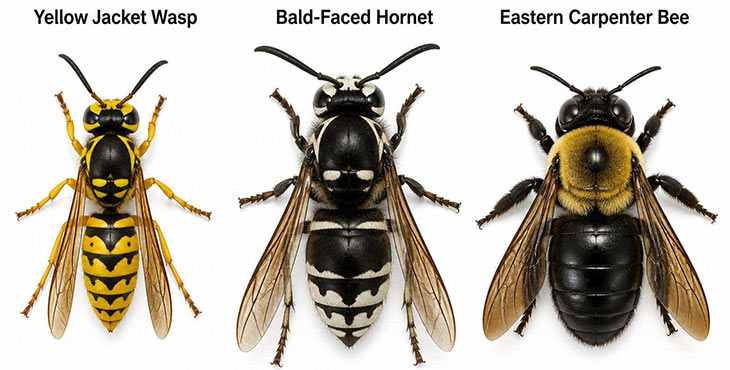
Yellowjackets
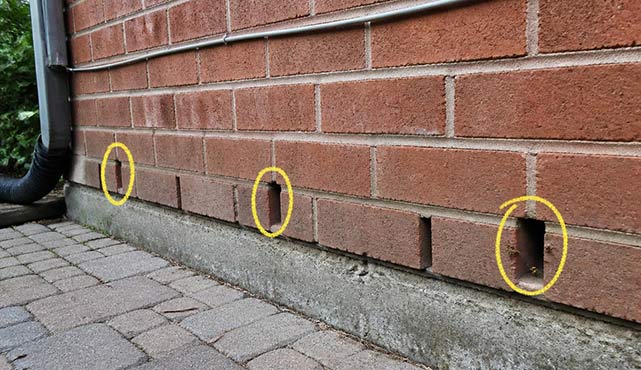
The wasps responsible for almost every sting complaint in the GTA. They nest in wall voids, soffits, attics, brick weep holes, and underground. Peak aggression: August–early October.
Bald-faced hornets
Large grey “football” nests hanging from trees, sheds, and eaves. Highly defensive within 3–4 metres of the nest. These need PPE and proper knockdown — do not attempt DIY.
European hornets
Larger than yellowjackets, active at dusk, drawn to porch lights. Nest in hollow trees and wall cavities.
Paper wasps
Open, umbrella-shaped nests under eaves, railings, and patio furniture. Less aggressive but sting readily if the nest is bumped.
Carpenter bees
The big black-and-yellow bees drilling perfectly round ~1 cm holes in cedar decks, fascia, pergolas, and unpainted trim. They rarely sting, but the structural damage — and the woodpeckers that follow them — is the real problem.
How Swift-X handles a wasp or hornet call
This is what actually happens when you book us — not a generic checklist.
1. Next-day inspection. A licensed tech arrives (unmarked vehicle available) and finds every active entry point, not just the obvious one. Yellowjackets often have a decoy hole and a real one a few feet away.
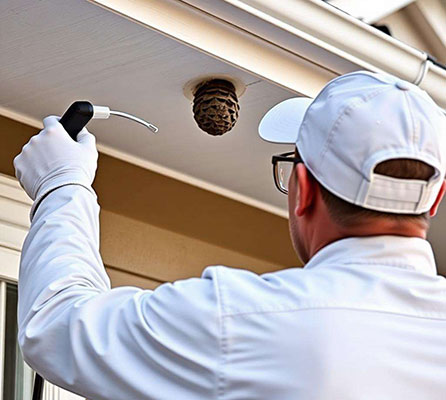
2. Direct-void treatment. We use a professional bellows duster to inject a residual insecticidal dust into the nest cavity itself — through the soffit, weep hole, or wall void. The dust coats returning foragers and gets carried deep into the nest by the workers themselves. This is what kills the queen. Aerosol sprays can’t do this.
3. Nest knockdown (when accessible). Exposed paper wasp and bald-faced hornet nests are physically removed once activity stops, usually the next day.
4. Exclusion. After the colony is dead, we will recommend the best practice to potential seal the entry point so a new queen can’t move into the same void next spring.
5. Follow-up. If you see activity within the guarantee window, we come back at no charge. In writing.
The Toronto & GTA wasp calendar
- April–May: Queens emerge and start small nests. Cheapest, easiest month to treat.
- June–July: Colonies grow fast. Carpenter bee drilling is at its peak.
- August–September: Peak aggression, peak sting calls, peak nest size. Most of our emergency calls land here.
- October: First frost kills workers; abandoned nests are not reused, but the cavity often is next spring — which is why exclusion matters.
Areas we cover
Toronto, North York, Scarborough, Etobicoke, Mississauga, Brampton, Vaughan, Markham, Richmond Hill, Oakville, Burlington, Ajax, Pickering, Whitby, Aurora, Newmarket, Milton, and Barrie / Innisfil.
Pricing & guarantee
- Flat-rate pricing quoted before we start — no hourly surprises.
- Written guarantee on every wasp, hornet, and carpenter bee job.
- Free callback if activity returns within the guarantee window.
- Pet- and child-safe protocols on request.
Book a Next-day visit
Call (647) 478-2128 — most calls answered in under 60 seconds.
Or request a free quote and we’ll text back within 15 minutes during business hours.
Want to learn more about identification?
Read our detailed field guide: Wasps, Hornets & Carpenter Bees in Toronto — how to tell them apart