

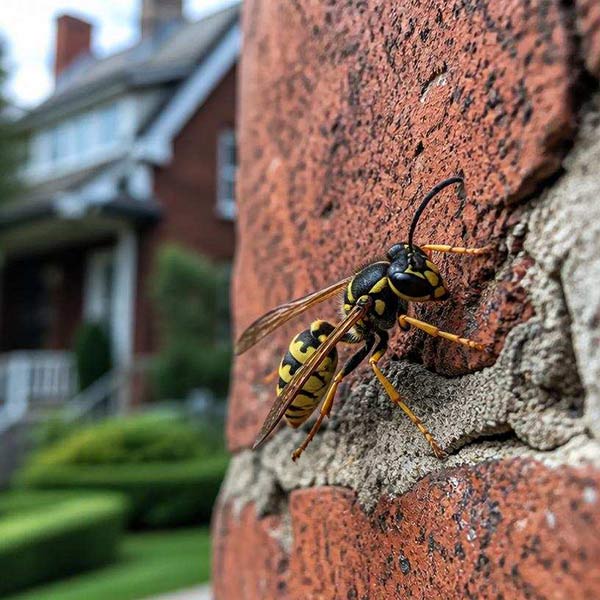
Every Toronto summer, our phones start ringing with the same question: “There’s something flying in and out of my house — is it a wasp, a hornet, or a bee?”
It matters more than most people think. The wrong ID leads to the wrong treatment, and knocking down the wrong nest can turn a nuisance into a swarm of stings. This guide covers the three stinging insects we see most across Toronto and the GTA — yellow jacket wasps, hornets, and carpenter bees — where they nest, and when to leave it to a licensed pro.
Quick answer: Swift-X Pest Control treats most wasp, hornet, and carpenter bee issues across the GTA — usually next-day. Call (647) 478-2128 for a free quote.
Wasp vs Hornet vs Carpenter Bee — Side-by-Side
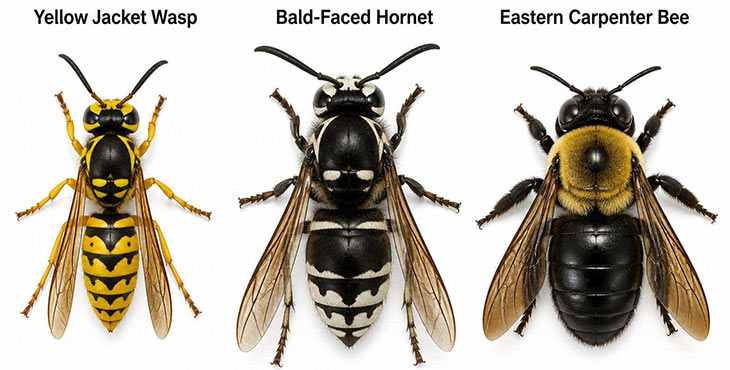
At a glance, all three look like “something that stings.” Up close, they’re very different insects with very different habits.
| Feature | Yellow Jacket Wasp | Bald-Faced Hornet | Eastern Carpenter Bee |
|---|---|---|---|
| Size | 10–15 mm | 18–20 mm | 20–25 mm (largest) |
| Colour | Bright yellow & black, smooth | Black with white/ivory markings on face & abdomen | Shiny black abdomen, fuzzy yellow thorax |
| Body | Slender, narrow waist | Larger, stocky, hairless | Round, robust, part-fuzzy |
| Nest | Paper nest — often underground, in wall voids, or under eaves | Large grey football-shaped paper nest in trees or under eaves | No nest — bores round tunnels into wood |
| Aggression | High, especially late summer | Very high near nest | Very low (males can’t sting) |
| Diet | Sugars, meat, garbage | Other insects, sugars | Nectar & pollen only |
A fast Toronto rule of thumb:
- Bright yellow and swarming your patio in August? Yellow jacket.
- Big grey papery football hanging in a maple tree? Bald-faced hornet.
- Large shiny black bee hovering around your deck rail, and you keep finding perfectly round holes in wood? Carpenter bee.
Yellow Jackets: The GTA’s #1 Wasp Problem
Yellow jackets (Vespula species) are, by a wide margin, the wasp Torontonians deal with most. They’re the ones dive-bombing your can of pop at a Trinity Bellwoods picnic in August.
Where they nest
- Underground — in old rodent burrows, along foundations, at the base of shrubs. You’ll see a steady stream of wasps coming in and out of a small hole in the lawn.
- Wall voids and soffits — they slip through gaps in siding, vents, or brick and build a nest you never see.
- Attics, sheds, and garages — quiet, protected spaces.
- Hanging paper nests under eaves and deck rails.
Why late summer is peak sting season
A colony that started with a single queen in May can hit 2,000–5,000 workers by August. Sugar sources also become scarcer, so wasps get bolder and more aggressive — this is when we get the most calls for stings around patios, garbage bins, and kids’ playsets.
Nest in a tree vs. inside your house – big difference
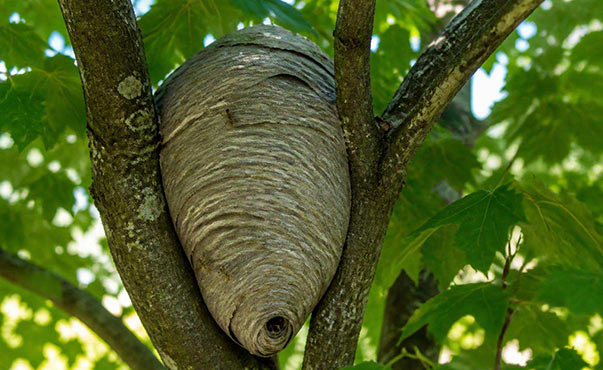
A visible nest hanging in a tree, shrub, or under an eave is usually straightforward: a licensed technician can treat and remove it in one visit.
A nest inside a wall, soffit, or under a deck is a different problem. You can’t just spray the entrance hole — a partially treated colony gets defensive, and sealing the hole traps hundreds of angry wasps that will chew their way into your living space instead of out. Never plug a wasp entry hole until the colony is fully eliminated.
Hornets in Ontario: What You’re Actually Seeing
True hornets are rare in North America. When Ontarians say “hornet,” they almost always mean one of these:
- Bald-faced hornet (Dolichovespula maculata) — technically a large aerial yellow jacket. Black with distinctive white face and markings. Builds the classic grey football-shaped paper nest hanging from tree branches, sheds, or eaves.
- European hornet (Vespa crabro) — the only true hornet in Ontario, but uncommon. Larger, brownish with yellow.
(Good news: the Asian giant hornet — the “murder hornet” — is not established in Ontario. If you’re seeing a large stinging insect here, it’s almost certainly a bald-faced hornet or a queen yellow jacket.)
Are hornet nests more dangerous than wasp nests?
Yes — in two ways:
- Bigger colonies. A mature bald-faced hornet nest can hold 400–700 workers.
- More defensive. They’ll aggressively defend a radius of several metres around the nest, and they can sting repeatedly without dying.
If you find a large football-shaped nest within 5 metres of a door, walkway, or play area, don’t try to knock it down yourself. Even at night, a partial hit turns the whole colony on you.
Carpenter Bees: The One That Damages Your House
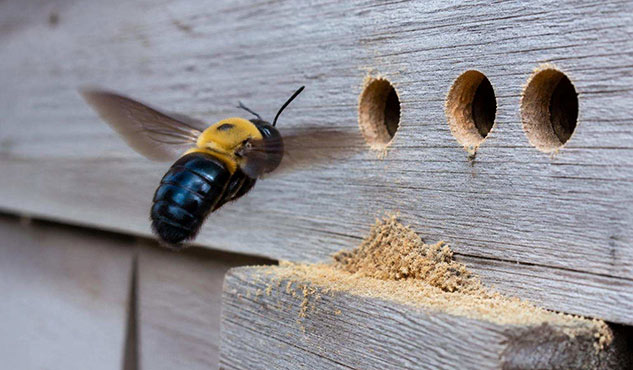
Carpenter bees are the gentle giants of the group — but they’re the ones most likely to cause actual structural damage.
How to identify them
- Large (20–25 mm), robust, mostly shiny black abdomen (bumble bees have a fuzzy yellow abdomen — carpenter bees look “bald” and glossy on the back).
- Fuzzy yellow thorax.
- Often seen hovering around wooden decks, fascia, railings, sheds, and cedar siding.
The damage: perfectly round holes
Female carpenter bees drill almost perfectly round holes about the diameter of a pencil (12 mm) into untreated or weathered softwood — cedar, pine, fir. They tunnel in and then make a 90° turn along the grain, extending the gallery to lay eggs.
Signs to look for:
- Round holes in deck rails, fascia boards, soffits, pergolas, sheds, or window trim.
- Fine sawdust piles on the ground or deck below the hole.
- Yellowish staining on the wood below the hole (waste from the tunnel).
- The same bees returning to the same wood year after year — new females often expand old galleries rather than start fresh.
Are they dangerous?
- Males can’t sting — the ones hovering aggressively at your face are almost always male, and they’re bluffing.
- Females can sting but rarely do unless directly handled.
- The real risk is cumulative wood damage — and the woodpeckers that follow, tearing chunks out of your fascia to eat the larvae inside.
Carpenter bees are not honey bees and are not protected in Ontario. Swift-X treats carpenter bee infestations directly and can advise on sealing and staining wood so they don’t return.
“Something Is Going In and Out of a Crack in My Brick”
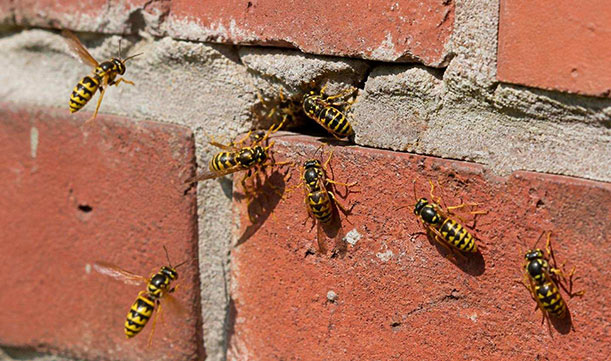
This is one of the most common calls we get from Toronto homeowners in July and August. You’re standing on the driveway, look up, and notice a steady stream of insects using a weep hole, cracked mortar joint, or gap where the brick meets the soffit as a highway.
Here’s how to think about it:
- Steady traffic in and out of a gap in brick, siding, soffit, or fascia = an active nest inside the wall or void. Don’t seal it.
- Yellow-and-black, smooth, fast-moving = yellow jackets using a wall void as a nest site.
- Big, black, slower, hovering nearby = carpenter bees tunnelling into wood trim beside the brick.
- Fuzzy honey bees using the same hole for weeks = possible honey bee colony inside the wall (rare, but requires special handling).
Why DIY spray usually fails on wall-void nests: The nest can be a metre or more inside the wall. Store-bought aerosols only reach the entrance. Wasps at the back of the nest survive, get agitated, and often find a second way out — sometimes into your bedroom or attic.
A proper treatment uses a dust or injectable product placed deep into the void so returning wasps carry it back to the colony. The entrance is left open for several days so foragers can bring the product in, and only sealed once activity has stopped.
When Should You Call Swift-X?
Call us if any of the following applies:
- You can see more than 10–15 wasps at the nest entrance at once.
- The nest is in a wall, soffit, attic, deck, or underground.
- The nest is a large grey football shape (bald-faced hornets).
- You have kids, pets, or allergy risk anywhere nearby.
- You’re finding round holes and sawdust in your wood (carpenter bees).
- You’ve already tried a spray and the wasps are now more aggressive — very common with wall-void nests.
Swift-X Pest Control treats most wasp, hornet, and carpenter bee issues in Toronto and across the GTA. Most jobs are handled next-day, and we back the work with a written guarantee — if activity comes back within the guarantee window, we come back at no charge.
Frequently Asked Questions
Will wasps come back to the same nest next year?
No — Ontario wasp and hornet nests are annual. The colony dies off in the fall and only new queens overwinter. But they do often reuse the same location (wall void, soffit, tree fork) year after year, because it’s a good site.
Should I knock down an empty nest in winter?
Yes. Removing old nests in late fall or winter and sealing the entry gap prevents a new queen from reusing the exact same spot next spring.
Are honey bees treated by Swift-X?
Honey bees are a special case. If you have an established honey bee colony (rare in walls in Toronto), we’ll usually refer you to a local beekeeper for live removal. Everything else — yellow jackets, hornets, carpenter bees, wasps of all kinds — we handle directly.
How much does wasp nest removal cost in Toronto?
Most exterior nests are a flat rate. Wall-void, soffit, and hornet nests are priced based on access and complexity. We provide a quote over the phone – no extras and no surprises.
Can I do it myself?
A single small paper wasp nest under an eave, at night, with the right protective gear, sometimes. Yellow jackets in a wall, bald-faced hornets, or anything you can’t see the full extent of — please don’t. The ER visits we hear about almost always start with “I thought it was a small one.”
Book Wasp or Bee Inspection
Call Swift-X Pest Control: (647) 478-2128
Licensed & insured Toronto exterminators. Next-day service across the GTA. Written guarantee on every treatment.