

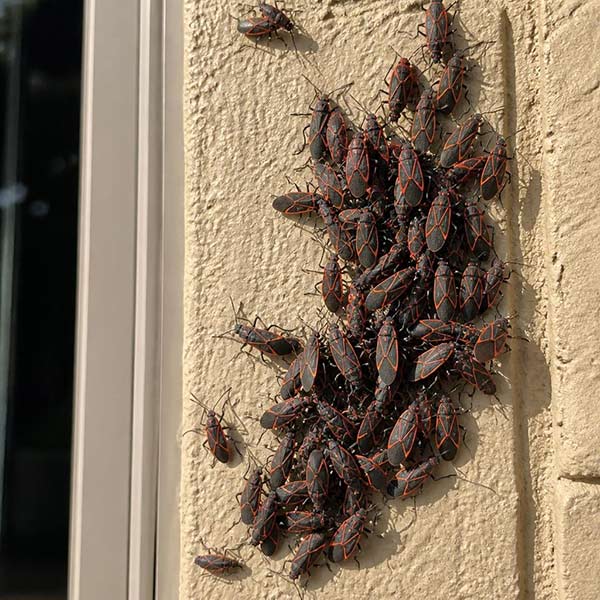
If you’ve walked outside on a warm, sunny day in the GTA and suddenly noticed hundreds of black-and-red bugs crawling up the side of your house, you’re not imagining it — and you’re not alone. Boxelder bug calls are one of the most common things we field at Swift-X Pest Control during warm spells in spring and fall.
The good news? They won’t destroy your home or bite your family. The bad news? They can be a real nuisance — and once a few slip inside, most homeowners want them gone yesterday.
If it seem that you have an immediate issue, feel free to give us a call for general advice, our treatment process, and a free quote.
Here’s everything you actually need to know.
What Are Boxelder Bugs?
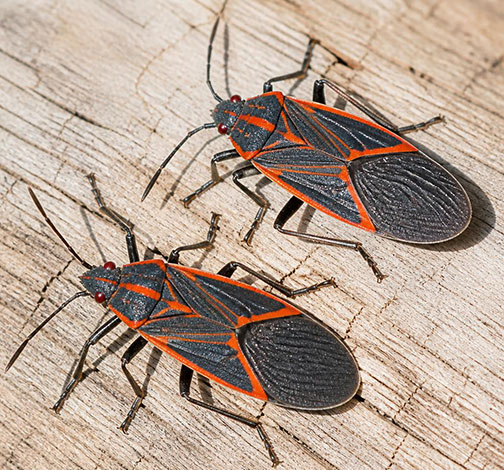
Boxelder bugs (Boisea trivittata) are true bugs, about 1/2 inch long, with elongated black bodies edged in bright red or orange lines. Look closely and you’ll see three red stripes on the thorax and a distinctive “X” pattern where their wings cross. Young nymphs are almost entirely bright red.
They get their name from their favourite host tree: the boxelder (also known as Manitoba maple, Acer negundo) — which happens to be extremely common across Toronto, Mississauga, Vaughan, and the rest of the GTA. They’ll also feed on silver maple, ash, and occasionally fruit trees.
Why Are There Suddenly So Many on My House?
This is the #1 question we get, and the answer surprises most people:
Boxelder bugs are sun-worshippers. On warm, sunny days — especially in spring and fall — they gather in massive numbers on south- and west-facing walls to bask in the heat. Light-coloured stucco, brick, and siding hold warmth better, which is why one house on the block gets swarmed while the neighbour’s doesn’t.
You’ll usually see them:
- Climbing up brick, stucco, or vinyl siding
- Clustered around windows, door frames, and soffits
- Sunning on decks, fences, and foundation walls
- Piling near seed pods under a nearby maple
In fall, they shift from basking to hunting for a place to overwinter — and that’s when they start pushing into your house through tiny cracks around windows, weep holes, vents, and utility penetrations.
Are Boxelder Bugs Destructive? Do They Bite?
Here’s the reassuring part. Boxelder bugs:
- Do NOT bite people or pets (they have a piercing mouthpart but use it on plant seeds, not skin)
- Do NOT sting
- Do NOT chew wood, wiring, or drywall like carpenter ants or rodents
- Do NOT reproduce indoors — the ones that get in can’t establish a colony in your walls
- Do NOT carry disease
So what’s the downside?
- They stain. If you crush them (or vacuum and dump them wrong), they release a foul-smelling orange fluid that can permanently stain curtains, carpet, upholstery, and light-coloured siding.
- They’re relentless. A big population on a warm wall can number in the thousands, and they seem to reappear the moment you clear them.
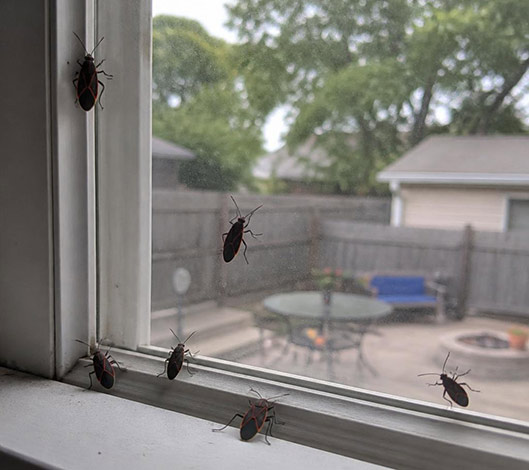
- They get indoors. Once inside, they’ll wander onto windowsills, ceilings, and light fixtures for weeks.
- They attract other pests. Dead boxelder bugs inside wall voids can feed carpet beetles and other secondary pests.
Why Are They Getting Inside My House?
They’re not trying to invade — they’re trying to survive winter. Boxelder bugs slip in through gaps you probably don’t even notice:
- Gaps around window and door frames
- Torn or missing screens
- Weep holes in brick veneer
- Soffit and fascia gaps
- Cracks in stucco or foundation
- Attic and roof vents
- Utility line penetrations (cable, gas, A/C)
Any opening the width of a pencil lead is enough. Older Toronto homes with brick, and newer builds with stucco, are especially prone.
Once inside, they’ll often stay hidden in wall voids and attics through winter — then wake up in late winter and early spring, confused, and crawl out onto your windowsills instead of back outside. That’s why some homeowners get a second wave in February or March even though they thought the problem was over.
What You Can Do Yourself
For a small outdoor cluster or a few strays inside, DIY steps can help:
Outside:
- Spray them off with soapy water. A strong squirt bottle with dish soap and water kills them on contact and won’t harm your siding.
- Rake up seed pods from under boxelder, maple, and ash trees in fall — this removes their food source.
- Trim back branches touching the house.
Inside:
- Vacuum them up — don’t squish. Use a bag vacuum or a shop vac with a bit of soapy water in the canister, then empty it outside immediately.
- Seal entry points with caulk around windows, door frames, and utility penetrations before fall.
- Repair or replace damaged screens and weatherstripping.
What doesn’t work: bug bombs, ultrasonic repellers, and most grocery-store aerosols. Boxelder bugs are surprisingly tough, and surface sprays lose potency fast in sun and rain.
When to Call a Pest Control Professional
You should call us if:
- You’re seeing hundreds or thousands on your walls repeatedly
- They keep getting inside despite sealing what you can see
- You have a boxelder or Manitoba maple on your property (or your neighbour does)
- You want to get ahead of the fall invasion before they overwinter in your walls
- You’re seeing them indoors in late winter/early spring, meaning they overwintered somewhere in the structure
How Swift-X Treats Boxelder Bugs in the GTA
Our approach is a two-part perimeter + exclusion treatment — because killing what you see doesn’t stop tomorrow’s wave:
- Targeted perimeter application on sunny walls, foundation, soffits, and around windows and doors with a residual product that keeps working for weeks — not the 20-minute knockdown you get from a hardware-store aerosol.
- Exclusion recommendations — we identify the specific entry points on your home (weep holes, torn screens, soffit gaps, foundation cracks) so you can seal the ones that matter and skip the ones that don’t.
- Timing that actually works. The two most effective treatment windows are early spring (when they emerge), and late summer / early fall (before they push indoors). We’ll schedule based on what you’re seeing.
Most GTA boxelder jobs are a single visit, flat-rate.
Boxelder Bugs vs. Other Look-Alikes
Homeowners sometimes confuse boxelder bugs with:
- Milkweed bugs — similar orange and black, but with a bold orange band pattern, and found on milkweed plants, not house walls.
- Western conifer seed bugs — larger, brown, and found near pines. Often mistaken for stink bugs.
- Brown marmorated stink bugs — shield-shaped, mottled brown, and release a much stronger odour. Also a growing problem in the GTA.
Boxelder Bug FAQs
These are the most-searched questions by Canadians about boxelder bugs — answered straight.
Are boxelder bugs harmful or dangerous?
No. They don’t bite (in rare cases their piercing mouthpart can prick skin if handled, but they’re not aggressive and it isn’t venomous), they don’t sting, they aren’t poisonous, and they don’t damage the structure of your home. The worst they’ll do is stain fabric or siding if crushed, and give off a mild odour.
Do boxelder bugs bite?
Effectively no. They’re a plant-feeding true bug — designed for maple seeds, not skin. You can pick one up without worrying.
What do boxelder bugs eat?
Primarily the seeds of boxelder (Manitoba maple), silver maple, and ash trees. They’ll occasionally feed on fruit like apples, plums, and grapes, but they don’t eat wood, fabric, food in your pantry, or other insects.
What kills boxelder bugs? / How do I get rid of them?
- On contact: a spray bottle of dish soap and water is the cheapest, safest thing that actually works.
- Indoors: vacuum (don’t crush), then empty the canister outside.
- Long-term: a professional residual perimeter treatment on sunny walls plus sealing entry points. Bug bombs, ultrasonic repellers, and most grocery-store aerosols don’t do much.
How do I get rid of boxelder bugs outside?
Focus on the three things they need: sun (you can’t remove it, but you can treat the warm walls they gather on), food (rake up seed pods under maple and boxelder trees in fall), and shelter (seal cracks, weep holes, and soffit gaps before autumn). One properly-timed perimeter treatment in late summer usually breaks the cycle.
How do I get rid of boxelder bugs permanently?
There’s no true “permanent” fix as long as you have host trees (yours or a neighbour’s) and sunny walls — but you can absolutely stop the yearly invasion. The combination that actually holds up: fall perimeter treatment + exclusion (sealing entry points) + spring follow-up. That’s the protocol we run for repeat-problem homes in the GTA.
How long do boxelder bugs live?
Adults live several months. The generation that overwinters in your walls can survive from fall through the following spring — which is why you sometimes see them crawling on windowsills in February.
Are boxelder bugs invasive?
Not in the technical sense — they’re native to North America, including Ontario. They just feel invasive because they gather in huge numbers.
If you’re not sure what you’re dealing with, snap a photo and text it to us — we’ll identify it and tell you honestly whether you need service or a can of dish soap.
The Bottom Line
Boxelder bugs are more of a nuisance than a threat — but “nuisance” doesn’t quite capture the feeling of watching a thousand of them cover your kitchen window on a Sunday morning. If DIY isn’t cutting it, or you want to break the cycle before fall, we can help.
Call Swift-X Pest Control at (647) 478-2128 for same-day service across Toronto, Mississauga, Vaughan, Markham, and the rest of the GTA. Licensed, insured, and guaranteed.