

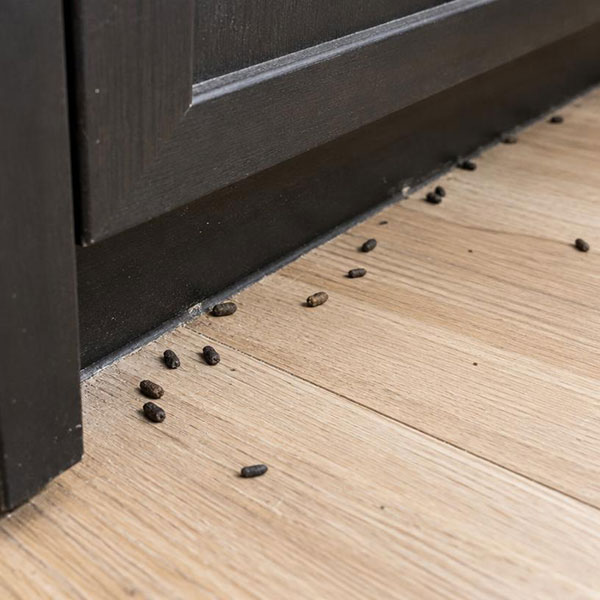
What do mouse droppings look like?
Mouse droppings are small — roughly 3 to 6 mm long, about the size of a grain of rice. Key features:
- Size: 3–6 mm (smaller than a grain of rice)
- Shape: Slender with pointed or tapered ends, sometimes slightly curved
- Colour: Dark brown to black when fresh; fading to grey and crumbly as they age
- Quantity: A single mouse produces 50–75 droppings per night, so you’ll rarely find just one
Fresh mouse poop looks moist and dark with a slight sheen. Older droppings dry out, turn greyish-brown, and crumble when touched. This difference matters: fresh droppings mean active activity right where you found them, while only old, dry droppings suggest the problem may have moved on (or been treated).
Seeing droppings in your home now and want to speak with an expert? Visit our Rodent Service Page, or give us a call/text at (647) 478-2128.
What do rat droppings look like?
Rat droppings are much larger — roughly 12 to 18 mm long, up to three or four times the size of mouse droppings:
- Size: 12–18 mm (up to the size of a raisin or larger)
- Shape: Blunt, capsule-shaped ends rather than points — more like a thick capsule or a large grain of cooked rice
- Colour: Dark brown to black when fresh, grey when old
- Quantity: Rats produce fewer droppings per night than mice — roughly 40–50 — but they’re far more conspicuous
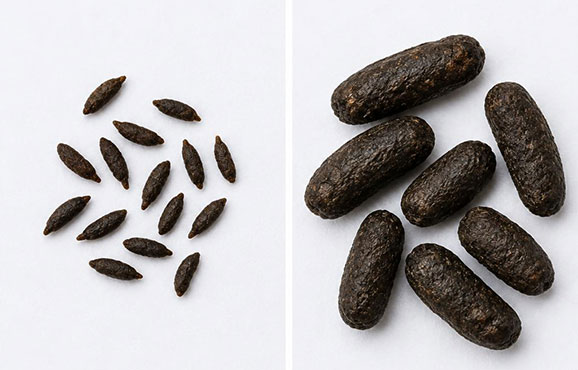
Mouse vs rat droppings: quick comparison
| Feature | Mouse droppings | Rat droppings |
|---|---|---|
| Length | 3–6 mm | 12–18 mm |
| Ends | Pointed / tapered | Blunt / rounded |
| Shape | Slim, rice-like | Thick capsule |
| Fresh colour | Dark brown to black | Dark brown to black |
| Old colour | Grey, crumbly | Grey, dull |
| Number per night | 50–75 | 40–50 |
| Where you’ll find them | Scattered along walls, in cabinets, drawers, pantries | Along runways, basements, behind appliances, crawl spaces |
Wait — what about a baby rat? (This trips people up)
Here’s the catch: a young rat’s droppings are about the same size as an adult mouse’s. A rat that’s a few weeks old isn’t much bigger than a mouse, so its droppings land right in the 6–8 mm range — bigger than a mouse’s, smaller than an adult rat’s.
How to tell a baby rat’s droppings from an adult mouse’s:
- Shape is the giveaway, not size. Even young rats produce the blunt-ended, capsule-shaped droppings typical of their species. A mouse’s droppings are pointed at both ends no matter its age. If the pellets are borderline-sized but blunt-ended, think rat.
- Quantity and spread. Mice scatter large numbers of tiny droppings widely (50–75 per day); young rats leave fewer, larger pellets concentrated along travel routes.
- Accompanying signs. Look for other evidence: gnaw marks (rat tooth marks are larger and paired further apart), greasy rub marks along walls (rats), or a one-mouse-sized hole the diameter of a dime (mice) versus a quarter-to-loonie-sized gap (rats).
- Scale check. Place a nickel beside the droppings for a photo. A pellet the length of the nickel’s thickness (about 2 mm) is a mouse; half the nickel’s diameter (about 10 mm) is likely a young rat.
If you’re seeing mid-sized, blunt droppings, you may have a young rat population that’s about to mature — which is a reason to act quickly, before the colony establishes itself.
Where to look for droppings in your home
Rodents follow walls and stay close to food. Check:
- Along the base of kitchen cabinets and behind the kick plates
- Under the sink, especially around pipe penetrations
- Behind the stove and fridge, where crumbs and warmth collect
- Pantry shelves and in the corners of drawers
- Basement rafters/joists, cluttered storage corners, and garage shelving
- Attic insulation (tunnelled runs) and along furnace ducts
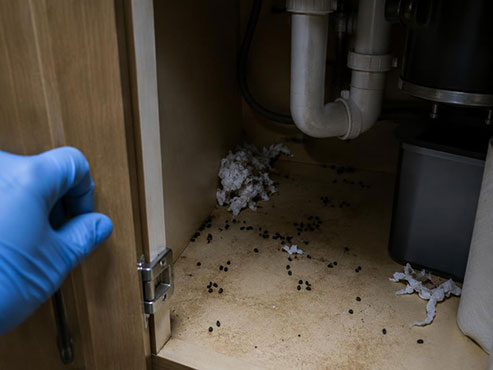
Fresh vs old: is the problem active?
- Fresh: dark, moist, slightly shiny, soft. Found near food or nesting sites.
- Old (days–weeks): dull grey-brown, dry, crumbling.
- Very old (months+): white/powdery, or completely gone.
A quick test: sweep the area clean and re-check in 24–48 hours. New droppings appear ? the infestation is active. This also helps you judge whether an old problem has returned or a treatment worked.
How mice and rats mark their trails with droppings
Ever wonder why droppings form neat little lines along the back of your counters instead of being scattered everywhere? Rodents are creatures of habit — they travel the same routes over and over, called runways, and they actively mark those routes.
Here’s what’s happening:
- Droppings mark the highway. Mice defecate constantly — as many as 50–75 times a day — and most of that happens while they’re moving along their route. The droppings you find are a physical record of the trail they travel, usually within about 30 cm (a foot) of a wall.
- Urine does the real communicating. The trail itself is signposted with urine containing pheromones. Mice and rats deposit tiny urine marks along their runways to signal “safe route” to other rodents, advertise territory, and announce mating status. Other mice read these chemical cues and follow the same path — which is why droppings keep appearing along the exact same line.
- Rats are even more rigid about it. Norway rats are famously conservative travellers, sticking to established runs between burrows and food. Their runways show greasy rub marks from body oils alongside droppings and urine trails, often along basements, crawl spaces and fence lines.
- The trail outlives the rodents. Urine pheromones can persist for weeks after the animals are gone — and they actively attract new mice to the same route. This is the main reason a “cleared” area gets re-colonized so quickly in the fall.
Why this matters practically:
- Follow the trail, don’t just clean the pile. A line of droppings is a map — it points toward both the food source and the entry point. Trace it to find where they’re getting in.
- Clean the urine, not just the droppings. Because pheromone trails attract new rodents, disinfecting the whole runway (walls, cabinet edges, pipe runs) matters as much as picking up pellets.
- A UV flashlight helps. Under ultraviolet (blacklight), dried mouse and rat urine glows bluish-white, revealing trails you can’t see otherwise — along baseboards, in drawers and on top of appliance frames.
- Seal the route. Until entry points are closed, you’re just repaving the highway for the next mouse.
Do rats hide their droppings?
Rats don’t deliberately bury or cover their droppings — but they’re much better than mice at keeping them out of sight. Rats defecate while travelling, and their runways tend to run through places homeowners rarely look:
- Inside wall and ceiling voids and under floorboards
- Through attic insulation, in tunnelled runs (like mice, but wider)
- Behind appliances and along pipe runs in basements
- In crawl spaces and along fence lines outdoors
The result: a serious rat infestation can exist with surprisingly few droppings visible in your living areas. If you suspect rats but can’t find droppings, look for these signs instead:
- Greasy rub marks — dark smudges along baseboards, beams and pipes where the rats’ fur and body oils repeatedly brush the surface
- Urine trails — glowing under a UV flashlight, just like with mice
- Gnaw marks and burrow openings — quarter- to loonie-sized holes
- Night-time sounds — rats are most active after dark
Rat droppings also break down faster than you’d expect: constant urine and foot traffic along a busy runway crumbles old pellets within days, so even fresh-looking evidence understates the problem. No visible droppings does not mean no rats.
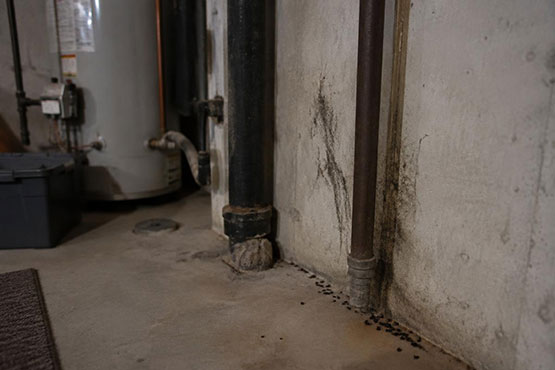
How to clean up mouse droppings safely (hantavirus risk)
Never sweep or vacuum dry droppings — that aerosolizes particles. Deer mice in Ontario can carry hantavirus, which survives in dried droppings and urine. Follow Public Health Ontario’s guidance:
- Ventilate the room for 30 minutes before cleaning (open windows, leave the area).
- Wear rubber or disposable gloves and an N95 respirator if available.
- Spray droppings and nesting material with a disinfectant (or a bleach solution: 1 part bleach to 10 parts water) until thoroughly wet. Let sit 5 minutes.
- Wipe up with paper towels and seal them in a plastic bag; dispose in a covered garbage bin.
- Disinfect the surrounding area, including floors, counters and cabinet interiors.
- Remove gloves last, wash hands thoroughly with soap and water.
Cleaned up a big pile in an enclosed space (cottage, shed, attic)? If you develop fever, muscle aches or shortness of breath within 1–5 weeks, seek medical care and mention the exposure.
Found droppings? Here’s what to do next
Droppings are just a symptom — the mice (or rats) are still inside, nesting and breeding. A pair of house mice can produce a litter every 3–4 weeks, so populations grow fast through the fall as they move indoors.
- Identify the species (this page helps) — mice and rats need different bait, trap placement, and proofing strategies.
- Find the entry points. Mice squeeze through dime-sized gaps; rats need quarter-sized holes. Check the foundation, garage door seals, utility penetrations, and roofline.
- Remove attractants: sealed food containers, pet food off the floor, decluttered storage, door sweeps.
- Trap and treat properly. Store-bought snap traps rarely resolve an established infestation — placement matters more than bait, and missed females keep breeding.
- Call a professional if droppings keep reappearing after a week of cleaning and trapping.
For a full walkthrough, see our guide to rodent control and mouse proofing in Toronto.
FAQ
How big are mouse droppings? About 3–6 mm — roughly the size of a grain of rice, with pointed ends.
How can you tell mouse poop from rat poop? Size and shape. Mouse droppings are small (3–6 mm) with pointed ends; rat droppings are large (12–18 mm) with blunt, capsule-shaped ends.
Are baby rat droppings the same size as mouse droppings? Close, but not identical. A young rat’s droppings (6–8 mm) sit between a mouse’s and an adult rat’s, and they keep the blunt, capsule shape. Pointed ends = mouse.
What does it mean when droppings are black vs grey? Black/dark and slightly shiny droppings are fresh, meaning the rodents are active in that area. Grey, dry, crumbling droppings are old.
Can mouse droppings make you sick? Yes. Dried droppings can carry hantavirus, salmonella and other pathogens. Never sweep or vacuum them dry — spray with disinfectant first, wear gloves, and ventilate the room.
How do you clean up mouse droppings? Ventilate for 30 minutes, wear gloves, spray with disinfectant or 1:10 bleach solution, let sit 5 minutes, wipe with paper towels, double-bag and dispose, then disinfect the area and wash your hands.
How many droppings does one mouse leave? A single mouse produces 50–75 droppings per day, scattered along walls and near food.
How do mice mark their trails? Rodents travel the same routes (runways) and mark them with urine containing pheromones — droppings accumulate along the trail as a byproduct because mice defecate while moving. Other rodents follow these chemical cues, which is why droppings keep reappearing along the same line.
Why do mouse droppings keep appearing in the same place after I clean? Lingering urine pheromones in the trail attract new mice to the same route — and can persist for weeks. Disinfect the entire runway, not just the droppings, and seal the entry points.
Can you see mouse urine trails? Yes — under a UV (blacklight) flashlight, dried rodent urine glows bluish-white, revealing trails along baseboards, in drawers and on appliance frames that are invisible in normal light.
Do rats leave trails like mice? Yes, and even more rigidly. Norway rats stick to established runs and leave greasy rub marks from body oils alongside droppings and urine trails, typically in basements, crawl spaces and along fence lines.
Do rats hide their droppings? Not deliberately — but rats drop as they travel through hidden runways (wall voids, attics, behind appliances, crawl spaces), so their droppings often go unseen. Look for greasy rub marks, urine trails under a UV flashlight, and gnaw marks instead.
Visit the Swift-X Rodent (mice/rats) Service Info Page
Mice in Walls: Signs, Sounds & How to Get Rid of Them | GTA