

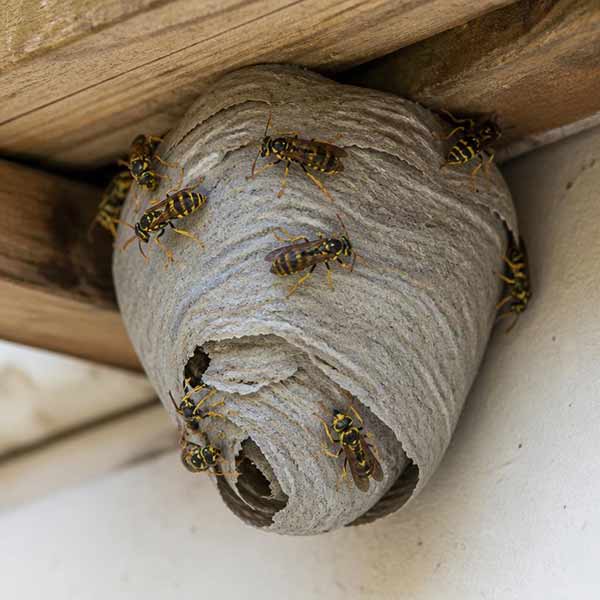
Late August and September are the busiest weeks of the year for stinging insect calls in Toronto and Barrie. Colonies that started as a single queen in May are now at full strength, food is getting scarce, and the workers are noticeably more aggressive than they were in June.
The first question almost every homeowner asks is the same: how much does wasp nest removal cost? The honest answer is that it depends far less on the company than on three things — what’s living in the nest, where the nest is, and how much risk is involved in getting to it.
Here’s how that breaks down.
Typical wasp nest removal cost ranges
For a single accessible nest at a Toronto or Barrie home, most professional treatments land in these ranges:
| Situation | Typical range |
|---|---|
| Yellowjacket nest inside a wall void, soffit, or ground burrow | $165 – $220 |
| Yellowjacket or paper wasp nest, reachable from the ground or a short ladder | $195 – $280 |
| Bald-faced hornet nest, elevated or exposed | $250 – $320 |
| Carpenter bee treatment (gallery holes along a deck, fascia, or railing) | $200 – $300 |
| Multiple nests on the same visit | Usually discounted per nest |
These are ranges, not quotes. A quick photo and a description of the location is normally enough for us to tell you exactly where you’ll fall before anyone comes out.
Yellowjackets: the most common — and the most common call
Yellowjackets build in wall voids, soffits, sheds, BBQ covers, and directly in the ground. That last one catches people mowing the lawn.
Ground-level and short-ladder yellowjacket nests sit at the lower end of the price range because treatment is straightforward: the technician applies product directly into the entry point, the returning foragers carry it into the colony, and activity typically collapses within 24–48 hours.
Cost climbs when the nest is inside a structure. A colony in a wall void or a soffit cavity can’t be seen or removed — it has to be treated through the entry point and monitored, and if the void has multiple exits, that’s more work and sometimes a follow-up visit.
Hornets: why the cost is higher
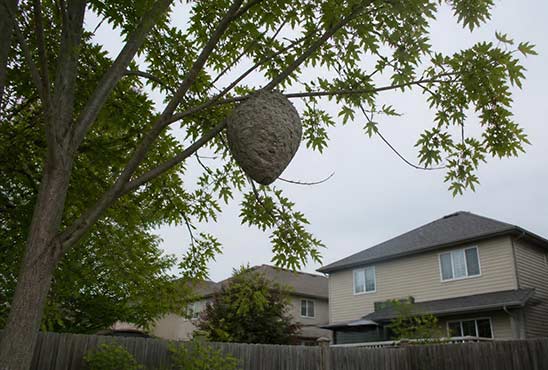
Bald-faced hornets are the grey, football-shaped nests hanging in trees, on eaves, and under second-storey overhangs. They cost more to remove, and it isn’t a markup — it’s genuinely a harder, riskier job:
- They defend aggressively and from a distance. Yellowjackets generally react when you’re at the nest. Bald-faced hornets will come at a technician several metres out, and they can sting repeatedly.
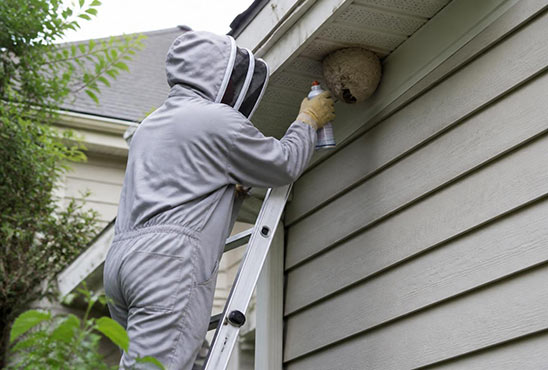
- The nests are usually high. Elevated work means an extension ladder, a spotter, and treatment done one-handed at height. That’s the single biggest cost driver.
- Full protective equipment is mandatory. A bee suit, veil, and gauntlet gloves in 30°C August heat limits how long a technician can work at a time.
- Colonies are large. A mature late-season hornet nest can hold several hundred workers, so it needs more product and a proper knockdown before the nest is taken down or left to die off.
If a hornet nest is above a doorway, a kids’ play area, a pool, or a walkway, don’t wait for a better price — that’s the one situation where a delay reliably ends in someone getting stung.
Carpenter bees: a different kind of job (and a different price)
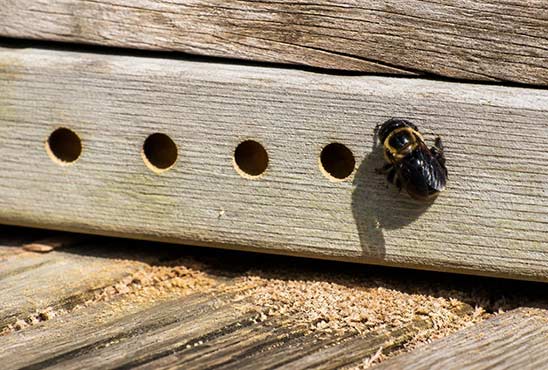
Carpenter bees aren’t aggressive — males hover and bluff, and females rarely sting. The problem is structural. Females bore perfectly round, dime-sized holes into untreated or weathered wood and tunnel galleries inside it: deck railings, fascia boards, pergolas, shed trim, and cedar siding. Look for the round hole plus a small pile of coarse sawdust beneath it.
Pricing sits in a similar band to yellowjackets because the labour is different rather than lighter:
- Each active gallery needs to be treated individually — there’s no single nest entrance.
- Holes should be treated first and sealed later, not sealed right away, or the bees simply chew a new exit.
- Woodpeckers often widen carpenter bee galleries hunting the larvae, which turns a cosmetic problem into a repair.
Treating in the same season, then filling and painting the wood, is what stops next year’s generation from re-using the same tunnels.
What actually changes your price
- Height. Ground level is cheapest. Second storey and roofline is the most expensive.
- Concealment. A visible nest is quicker than a colony inside a wall.
- Number of nests. Two or three treated in one visit costs far less than three separate calls.
- Access. Locked gates, dense landscaping, decking that has to be worked around, or a nest over a pool all add time.
- Season. Late-season colonies are bigger and take more product than a small June nest — one more reason not to put it off.
- Warranty. Our stinging insect treatments include a return visit if activity continues within the warranty window, which is worth checking against any quote you compare.
Why DIY spray cans often cost more in the end
A hardware-store jet spray can work on a small, exposed, ground-level paper wasp nest. It reliably fails in three scenarios:
- Wall voids — surface spray kills the workers you see and drives the rest deeper into the structure, sometimes into the living space.
- Elevated nests — spraying up a ladder means angry hornets and an unstable footing at the same time.
- Carpenter bees — a spray at the hole entrance doesn’t reach the larvae inside the gallery.
Add the cost of two or three cans, a repeat attempt, and possibly an ER trip for a sting reaction, and a professional treatment usually looks cheaper.
When to call right away
- Anyone in the household has a known sting allergy
- The nest is near a door, deck, patio, pool, or play area
- Activity is coming out of a wall, soffit, or vent
- A grey football-shaped hornet nest anywhere on the property
- Round holes and sawdust on a deck or fascia board
Book wasp or hornet nest removal in Toronto or Barrie
Swift-X Pest Control handles yellowjacket, paper wasp, bald-faced hornet, and carpenter bee treatments across Toronto, the GTA, Barrie, and surrounding areas — with next-day service in most cases and discreet, unmarked arrival.
Call or text us with a photo of the nest and we’ll give you a firm price before we book.
For a deeper look at telling these species apart, read our guide on yellowjackets, hornets, and carpenter bees and our post on yellowjacket nest removal.